
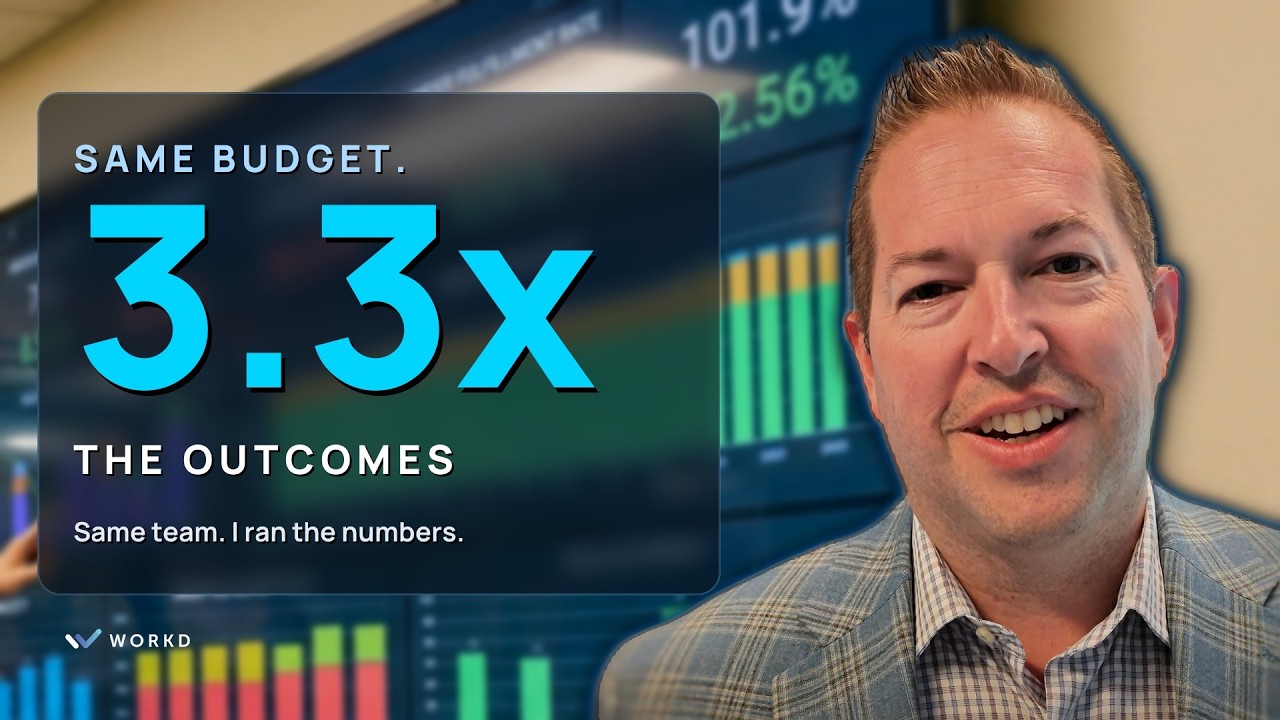
This is the version of the AI agent conversation I wish someone had given me a few years ago. No hype. Just what these things are good at, where they fall on their face, and how to get from “we should look at AI” to an agent that pays for itself.
It runs about half an hour. If you only have five minutes, the chapters in the video description will get you to the two live calls. Here is the shape of the argument.
Four questions that decide if AI can do a job
Most people assume most jobs are too complicated for AI. The test is simpler than that. Ask four things about the job:
- Can you understand it?
- Can you sequence it?
- Can it be scripted?
- Can it be repeated?
If you could sit an associate down and train them to do it, there is a very good chance an agent can do something close. Sales prep, follow-ups, appointment setting, collections calls, service questions, FAQs. All of those pass the test.
The follow-up question is the one people get wrong. Will most jobs in B2B eventually be done by agents? I do not believe that, and I sell them. Agents are excellent at tight, scripted work. When a job turns on relationship, judgment, trust, negotiation, or a situation nobody has seen before, that is where people belong. The right model is a hybrid, and the talk spends real time on where the line sits.
Where the week actually goes
The reason this matters is how little of a working week is spent on the job you hired someone for. Third-party research puts it bluntly: knowledge workers spend most of their time on work about work, and one large CRM vendor’s own study found its reps spend well under a third of their week actually selling. The rest is chasing documents, updating status, and sitting in meetings.
That busy work is exactly the kind of scripted, repeatable task an agent handles well. Shift it, and you get more out of the people you already have. They are also happier, because nobody wants to spend their day on the parts they were going to skip anyway.
The three steps
The talk lays out a three-step system.
Step one: point it at the biggest impact. Revenue lift first, cost and time savings second. Start with the low-hanging fruit: reaching more leads, reactivating dormant accounts, or giving the outside sales team an assistant. Pick a couple of use cases where the return shows up fast.
Step two: connect your data. An agent that does not know your customers, your orders, and your pricing is a toy. This is where most of the real work is, and it is the reason we built the agents inside the system of record instead of beside it.
Step three: build the flows. Script the happy path, then the objections. The agent follows the script, gets knocked off it by whatever the person on the other end says, and gets back on track.
The math, and what happens when the agent is only half as good
The middle of the talk works a cost-per-success example for an appointment setter, comparing a salaried person to a voice agent doing the same activity on a per-minute utility cost. The numbers are a worked example, not a benchmark, and the video walks through every line so you can put your own in.
The part that surprised me most is what happens when you assume the agent is only half as effective as your best person. The economics still hold. That is not an argument for replacing people. It is an argument for handing the routine volume to the agent and keeping your people for the calls that need them.
It also changes how you scale. The old way was headcount: five people to ten to fifty, because you needed the outcomes. An agent scales like a utility. You buy more of it when the season spikes and less when it does not, and you never have to staff for the peak.
Two live calls, unedited
The talk includes two calls with no editing.
In the first, an agent books a tasting for a cidery’s sales rep with a bar owner who pushes back on the time. Twice. It handles the objection, offers alternatives, confirms the address and the head count, and locks the slot.
In the second, an outside rep calls his assistant from the truck before walking into an account. Credit situation, open orders, what the buyer said last time, what is on special. All of it, in one conversation, with nothing typed. That is the field side of Workd Voice.
The rep who never took a note
Near the end there is a story about an old-guard sales rep who had never logged a note in his career and had no intention of starting. What changed his mind was not a better CRM. It was being able to talk. If you manage an outside team, that story is the one to watch.
If you run a B2B team and are trying to work out which part of this wave is real, this is the honest version. Call our AI at (248) 522-9680 and it will book you a demo, which is still the fastest way to understand what these agents do.