
Dispatch builds routes around your trucks, customers and schedules. Drivers get a guided stop-by-stop app, and every morning the office sees whether everything delivered got billed and collected. Customers get proof with their invoice.
That's the question every distributor running its own trucks asks on Friday afternoon. Paper manifests, separate routing tools and invoices typed after the fact make it hard to answer.
Short deliveries turn into disputes, card holds get stranded, and money leaks between the truck and the ledger.
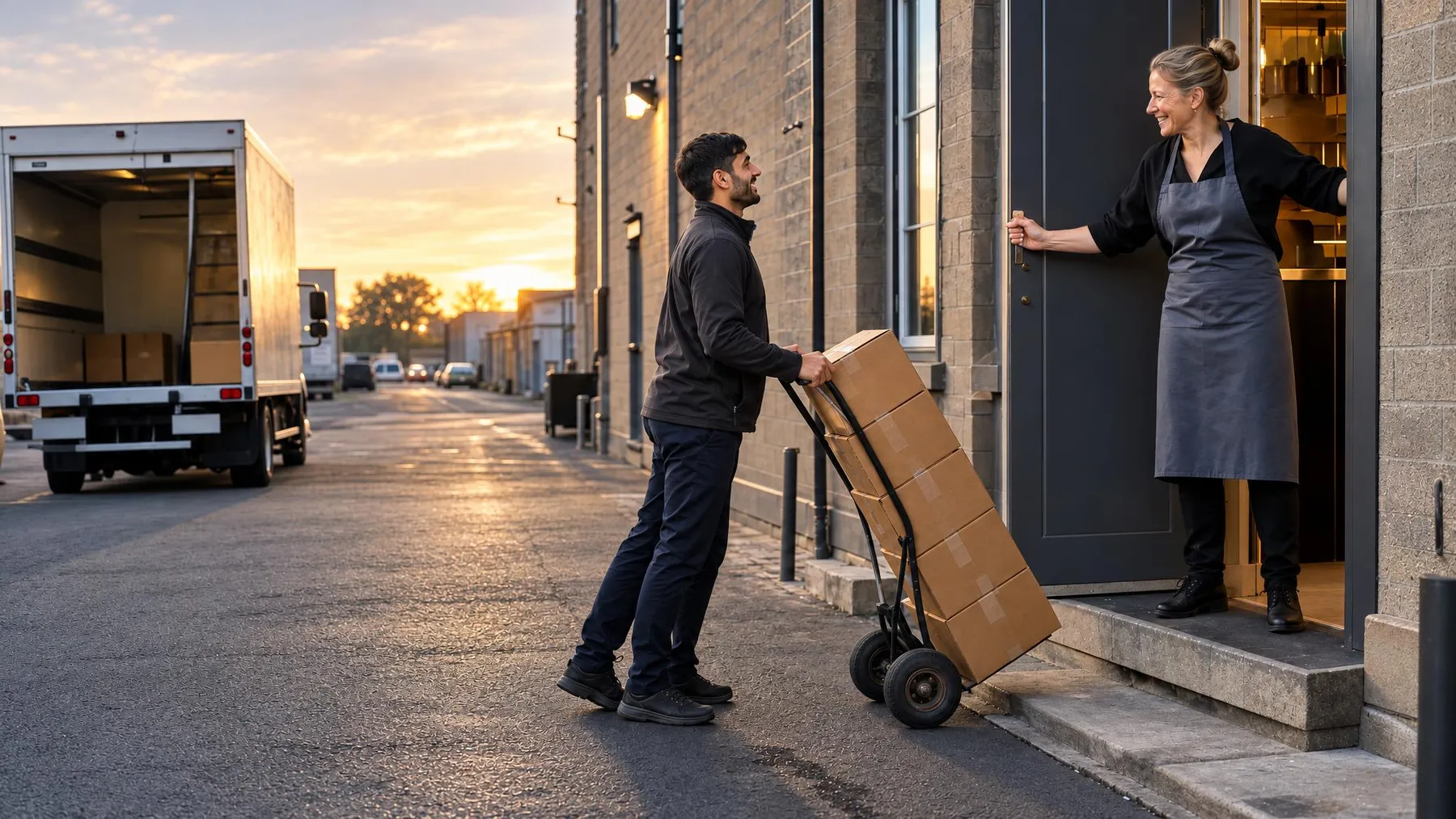
Proof of delivery goes out with the invoice.
Auto-sequence stops around truck capacity, priorities, standing schedules and day or night delivery windows.
Drivers follow a guided stop workflow with one-tap navigation, even when a dead zone drops GPS.
Photos, signature and a GPS-stamped arrival. The confirmed quantities become the invoice.
Every order traced from ordered to delivered to billed to collected, with leaks flagged by name.
8-minute walkthrough: the paper-driven delivery day vs. the driver app, from DOT checklist to reconciliation
Truck capacity, stop priority, multi-trip planning, standing routes and pinned accounts that can’t move.
Every truck on one board, with GPS, speed and fuel from your fleet telematics, and stops that need attention.
Before and after photos, signature and GPS-stamped arrival, embedded in the customer’s invoice.
Texts and emails when the driver is en route, and a confirmation with photos when the stop is done.
Cash, check or card, split payments, and credits issued on the spot with a photo and a reason.
Delivered but not invoiced, billed but not collected, duplicates and stranded card holds, each with a fix.
Card and ACH payments checked overnight, and one email each morning listing every dollar at risk.
DOT-style checklists with photos. A defect opens a tracked issue, and the truck rolls only after approval.
Load sheets, one-tap refills mid-route, returnable containers and post-trip check-in against what should be back.
Yes. It runs in production today, reconciling a Michigan distributor’s own delivery fleet every morning.
The quantities the driver confirms at the door become the invoice. Undelivered lines are never charged, and the shortfall becomes a new order instead of a dispute.
The driver workflow is built for dead zones. Arrival still records when GPS drops out, and the driver can always move the route forward.
Yes. Customers who can only take daytime deliveries never end up on a night route.
Yes. The dispatch board pulls GPS position, speed and fuel from your fleet telematics.
Distributors from $5M to $1.5B run their sales, orders and deliveries on Workd. Live on the ERP you already run in two to four weeks.
 Salesforce
 HubSpot
 Microsoft Dynamics
 Epicor Prophet 21
 NetSuite
 SAP
 Sage
 Acumatica
 QuickBooks