
RFID Is Going Vendor-Agnostic, And Mid-Market Distributors Should Pay Attention


For years, RFID in distribution meant picking a vendor and hoping you picked right. Proprietary tag formats, incompatible readers, and closed ecosystems turned what should have been a straightforward inventory upgrade into a high-stakes commitment. That's starting to change, and fast.
In August 2024, pharmaceutical distributor Cencora partnered with Intelliguard to make RFID-tagged medications compatible across medication management systems regardless of vendor. It was a quiet announcement, but it signaled something larger: the distribution industry is moving toward vendor-agnostic RFID, and the implications for mid-market operators run deeper than most realize.
The Numbers Behind the Acceleration
RFID isn't a niche technology anymore. According to a RAIN Alliance internal report published in March 2025, 52.8 billion RAIN UHF RFID tag chips shipped in 2024, a 17 percent increase over 2023's 44.8 billion units. That figure represents a 54 percent increase in just two years.
52.8 billion RFID tag chips shipped in 2024
A 54% increase in two years, RAIN Alliance, March 2025
"The scale of demand is notably marked by a 54 percent increase in RAIN tag chip shipments in just two years," said Aileen Ryan, RAIN Alliance president and CEO. VDC Research projects annual shipments will surpass 115 billion by 2029, more than doubling today's volume.
What's driving this? Falling costs. Passive UHF RFID tags now run between $0.10 and $0.50 per unit in bulk, according to industry pricing data from early 2026. For a mid-market distributor handling 50,000 SKUs, that puts full item-level tagging within reach, something that would have cost ten times as much a decade ago.
Why Vendor Lock-In Has Been the Real Barrier
Cost isn't what's kept most distributors from deploying RFID. The real problem has been interoperability, or the lack of it.
When a distributor tags inventory with one vendor's system, those tags often can't be read by a customer's readers, a logistics partner's scanners, or even a different system within the same warehouse. The result is fragmented data, duplicated effort, and a technology investment that stops delivering value the moment product leaves the building.
This is exactly the problem Cencora and Intelliguard attacked. Their partnership made it possible for Intelliguard's Mira Prep and Mira Care stations to read and decode Cencora's RFID-tagged medications, systems that previously couldn't talk to each other. Tim Tinnel, COO of Intelliguard, framed it plainly: the goal is "reducing time-consuming, manual processes" and letting healthcare facilities "maximize ROI" from existing RFID investments.
Pharma distribution is the canary in the coal mine. The Drug Supply Chain Security Act (DSCSA) already requires serialized tracking for pharmaceuticals, which pushed companies like Cencora to adopt RFID early. Now that the interoperability problems are being solved in pharma, the playbook is migrating to general distribution.
What Vendor-Agnostic Actually Means for Operations
For a $50M electrical distributor or a regional food service wholesaler, vendor-agnostic RFID changes the calculus in three concrete ways.
First, it eliminates switching costs. When tags follow open standards, like the RAIN RFID protocol built on ISO/IEC 18000-63, distributors can change readers, software, or integration partners without re-tagging inventory. That turns RFID from a capital commitment into an operational expense.
Second, it enables supply chain continuity. If a manufacturer source-tags products with interoperable RFID, a distributor can read those tags on receipt, track them through the warehouse, and pass the data downstream to customers, all without adding their own tags. Kroger demonstrated this in late 2024 when it began rolling out RFID-embedded labels in its bakery department, with plans to extend to other perishables. That kind of source-to-shelf visibility only works if the tags are vendor-neutral.
Third, it makes phased adoption practical. A distributor doesn't need to RFID-tag every product on day one. Start with high-value or high-shrink categories, prove the ROI, then expand. Open standards mean the infrastructure you install today won't be obsolete when you scale tomorrow.
The Inventory Accuracy Gap
The business case for RFID in distribution centers isn't theoretical. Research from Auburn University's RFID Lab found that RFID increases inventory accuracy from an average of 65 percent to more than 95 percent. A peer-reviewed study published in the International Journal of Production Economics found that RFID improved distribution system performance, including products dispatched and inventory in transit, by 33.8 percent, with stock availability improving by 45.6 percent.
65% → 95%+ inventory accuracy
Auburn University RFID Lab research on inventory accuracy improvements
For mid-market distributors still running annual or quarterly physical counts, those numbers translate directly to fewer stockouts, less dead inventory, and faster order fulfillment. Industry benchmarks suggest warehouse-only RFID implementations typically achieve payback in 18 to 24 months, driven by labor savings, reduced picking errors, and improved inventory turnover.
Decathlon, the global sporting goods retailer, offers a useful parallel. The company tagged its entire product range with GS1-standard RFID and achieved near-complete inventory visibility across its supply chain. While Decathlon operates at a different scale than most distributors, the underlying principle holds: standardized, interoperable tagging compounds in value as it extends across the supply chain.
The RAIN Alliance and the Standards Push
The RAIN Alliance, whose members include NXP Semiconductors, Impinj, and Zebra Technologies, has been the primary force behind standardizing UHF RFID. The alliance's work on the RAIN protocol ensures that any compliant tag can be read by any compliant reader, regardless of manufacturer.
In early 2026, the alliance noted that RFID use cases are expanding beyond retail and logistics into healthcare, food safety, and industrial supply chains. Checkpoint Systems recently integrated NXP's new UCODE X chip into its smart labels, pushing read performance higher while maintaining backwards compatibility, another sign that the ecosystem is coalescing around open standards rather than fragmenting into proprietary camps.
For mid-market distributors evaluating RFID, this standards convergence is the single most important development. It means the technology risk has dropped significantly. A distributor investing in RAIN-compliant infrastructure today is buying into an ecosystem with 52.8 billion chips shipped last year and a trajectory toward 115 billion by the end of the decade.
What Mid-Market Distributors Should Do Now
RFID adoption doesn't require a million-dollar commitment or a six-month implementation. Here's a practical starting point:
Audit your highest-value inventory categories. Identify the 20 percent of SKUs that drive 80 percent of revenue or carry the highest shrink rates. These are your pilot candidates.
Ask your ERP vendor about RFID integration. Most modern ERP and WMS platforms, including NetSuite, Epicor, and Infor, support RFID data ingestion. The integration work is often simpler than distributors expect.
Insist on RAIN-compliant hardware. Any reader, tag, or antenna purchase should be RAIN-certified. This is non-negotiable if you want to avoid the vendor lock-in that plagued earlier adopters.
Talk to your suppliers. If key manufacturers are already source-tagging products, you may be able to skip the tagging step entirely and capture data from tags that arrive on your dock.
Is your ERP ready for modern inventory technology?
Find out where your systems stand with our quick assessment
Take the AssessmentThe Window Is Open
The distribution industry is in an unusual position. The technology is mature, the costs have dropped, and the standards have converged, but adoption among mid-market distributors remains low. According to MarketsandMarkets, the tags segment accounted for approximately 51 percent of the total RFID market in 2024, with retail and supply chain operations driving the bulk of deployments. Most of that adoption has been concentrated among large enterprises.
That gap is an opportunity. Distributors who deploy interoperable RFID now will have better inventory data than competitors who are still counting by hand. They'll fulfill orders faster, carry less safety stock, and lose fewer customers to stockouts.
The Cencora-Intelliguard partnership wasn't just a pharma story. It was a signal that the distribution industry has stopped debating whether RFID works and started solving the real problem: making it work across the entire supply chain, regardless of whose name is on the hardware.
For mid-market distributors, the question is no longer whether to adopt RFID. It's whether to adopt it now, while interoperability is becoming standard and before competitors close the gap.
Stay ahead of the curve
Get weekly insights on distribution technology and AI automation.
Go Deeper in the Resource Library
Get AI prompts, implementation templates, SOPs, and call scripts built for distribution companies. 47+ resources and growing, free access.
Access the Resource Library, FreeAlso free: Workdshop live sessions for distribution leaders
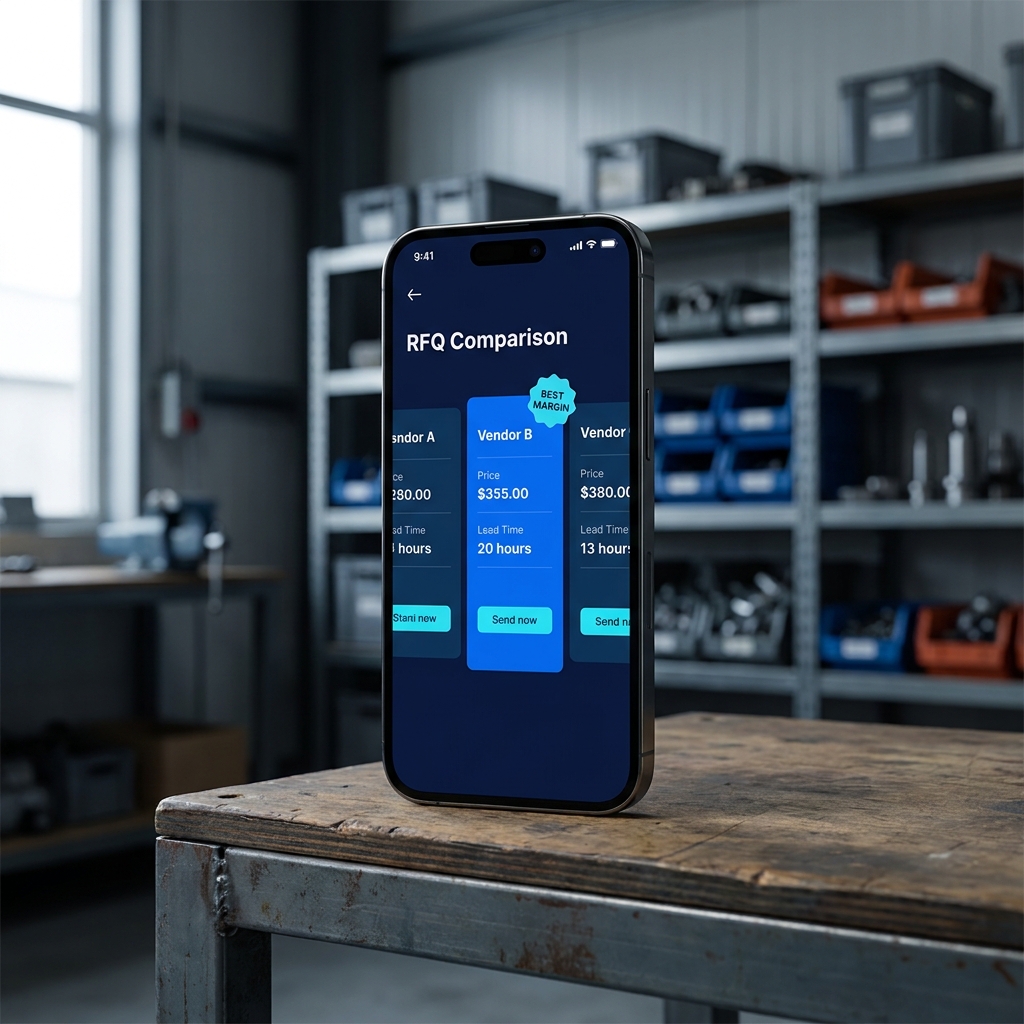
Stop losing margin in the email thread.
Vendor RFQs linked to customer quotes, sales sees real-time vendor pricing on every active quote.
Free Sourcing Audit