
The K-Shaped Manufacturing Economy: Why AI-Adopting Distributors Are Pulling Away While Everyone Else Falls Behind

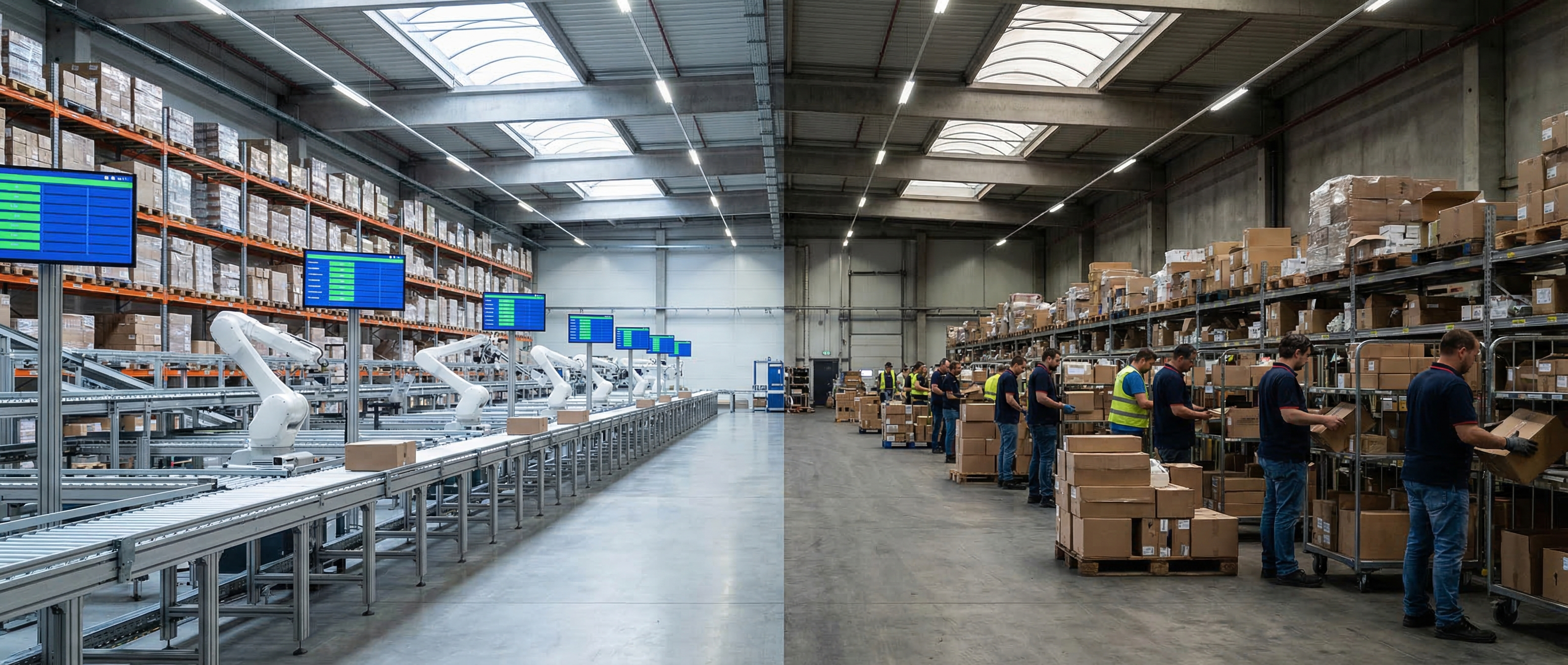
U.S. manufacturing production grew in 2025. Manufacturing employment fell, for the third consecutive year. That single contradiction explains more about the state of American distribution than any earnings call or trade publication forecast.
According to Bureau of Labor Statistics data, manufacturing employment edged down from 12.71 million workers in September 2025 to 12.69 million by December, continuing a decline that has shed roughly 60,000 jobs since the sector's post-pandemic employment peak in February 2023. Yet total manufacturing output kept climbing. The gap between those two lines, more production, fewer people, is the defining feature of what economists now call the K-shaped manufacturing economy.
"In 2025, while total U.S. manufacturing production rose, the total number of Americans employed in the manufacturing sector fell. We attribute this to increased automation, a phenomenon that will only be enhanced by increasing adoption of robotics and AI technologies.", Quality Magazine, 2026 Manufacturing Outlook
For mid-market distributors, the $10M-to-$500M operators that form the backbone of American wholesale, this divergence is not academic. It is splitting the industry into two distinct groups: those using automation to capture the productivity gains, and those watching their margins erode as labor costs rise and competitors get faster.
The Numbers Behind the Split
The productivity data tells a stark story. U.S. nonfarm business productivity surged 4.9% in Q3 2025, according to LPL Research analysis of BLS data, driven largely by output growing 5.4% while hours worked rose just 0.5%. Companies produced dramatically more with barely any additional labor. Manufacturing-specific output per hour rose 2.4% year-over-year from Q3 2024 to Q3 2025, the strongest same-quarter gain since early 2011, per AMTEC workforce analysis.
That productivity growth is not evenly distributed. Deloitte's 2025 Smart Manufacturing and Operations Survey found that 80% of manufacturers now plan to allocate at least 20% of their improvement budgets to smart manufacturing initiatives, automation hardware, data analytics, sensors, and AI. The companies making those investments are the ones driving the productivity numbers. Everyone else is running harder just to stay in place.
McKinsey's 2025 State of AI survey reported that 78% of organizations use AI in at least one business function, up from 55% just two years earlier. But that headline number obscures a critical detail: 23% of respondents said they are already scaling agentic AI systems, autonomous tools that execute multi-step tasks without human intervention. The companies in that 23% operate in a fundamentally different competitive environment than the 77% that do not.
What the J-Curve Research Actually Shows
A common objection to aggressive AI adoption is that early investments frequently underperform. New research from MIT Sloan and the U.S. Census Bureau confirms this, and then demolishes the argument for waiting.
The study, published in 2025 as "The Rise of Industrial AI in America," tracked tens of thousands of manufacturing companies through Census Bureau surveys in 2017 and 2021. Researchers found that AI adoption did initially reduce productivity by a measurable margin. Firms experienced what the authors call a "J-curve", a dip before the climb.
"AI isn't plug-and-play," said University of Toronto professor Kristina McElheran, one of the study's lead authors. "It requires systemic change, and that process introduces friction, particularly for established firms."
But over the four-year study period, AI-adopting firms consistently outperformed non-adopters in both productivity and market share. The short-term adjustment cost was real. The long-term advantage was larger.
"Once firms work through the adjustment costs, they tend to experience stronger growth. But that initial dip, the downward slope of the J-curve, is very real.", Kristina McElheran, MIT Initiative on the Digital Economy
The implication for distributors considering AI investments: the cost of adopting is temporary. The cost of not adopting compounds.
See how much revenue you're leaving on the table
Take our 2-minute Revenue Leakage Assessment
Start AssessmentWhy Distribution Gets Hit Harder Than Manufacturing
Manufacturing at least has the advantage of clear automation targets: repetitive assembly, quality inspection, materials handling. Distribution's automation opportunities are less obvious but equally consequential.
Consider the daily operations of a $50M electrical supply distributor. Order entry. Inventory allocation. Route optimization. Credit checks. AR follow-up. Pricing exceptions. Customer onboarding. Each of these tasks involves semi-structured decision-making that AI handles effectively, and each one currently consumes hours of human labor that competitors are eliminating.
The K-shaped economy report from U.S. Bank, published March 2026, frames this precisely: "Businesses that fail to adopt these technologies risk falling behind in both productivity and profits. Without broader access to AI and automation tools, income inequality will continue to widen." That analysis applies to businesses as much as households. A distributor running manual AR collections is not just slower than an automated competitor, it is structurally more expensive to operate, with that gap widening every quarter.
Reuters reported in January 2026 that U.S. factory headcount continued falling despite manufacturing investment surges, with job creation pace dropping more than two-thirds from the prior year. The same dynamic is playing out in wholesale distribution, where labor costs continue rising while the tasks that labor performs become increasingly automatable.
The Tariff Accelerant
The current tariff environment has poured fuel on the divide. As Quality Magazine's outlook noted, tariffs have created "a slightly more favorable operating environment for domestic manufacturers" while simultaneously raising input costs for companies that import components through Asian supply chains. Distributors handling imported goods face margin compression from both directions: higher costs on inbound product and customers demanding the same or lower prices.
Companies with automated pricing engines, real-time cost modeling, and AI-driven procurement can adapt to tariff shifts within days. Companies relying on quarterly spreadsheet reviews and manual price updates absorb weeks of margin erosion before anyone notices. That gap, the speed of response, is where the K-shape becomes most visible in distribution.
Deloitte's 2026 Manufacturing Industry Outlook explicitly tied AI investment to tariff resilience, noting that manufacturers focused on "targeted technology investments, particularly in agentic AI" are better positioned to drive agility despite economic uncertainty. The same logic applies downstream. Distributors with intelligent systems monitoring cost fluctuations, adjusting pricing in real time, and flagging margin anomalies operate in a different reality than those that do not.
The Labor Equation Has Permanently Changed
The Cato Institute reported in January 2026 that manufacturing employment fell for the third consecutive year through December 2025, calling it evidence that tariff-driven reshoring has not translated into job growth. Deloitte's analysis of BLS data confirmed that costs rose and employment fell across the manufacturing sector throughout the year.
For distributors, the labor picture is equally constrained. Warehouse workers, drivers, inside sales reps, and AR specialists are all in short supply and commanding higher wages. The companies solving this through automation are not just cutting costs, they are removing a structural vulnerability. A distributor that needs 40 warehouse workers to process 5,000 orders per day is fundamentally more fragile than one that needs 25 workers for the same volume.
Physical AI, the application of AI to real-world operations including robotics, logistics, and warehouse management, is accelerating this shift. Deloitte's State of AI report projected that physical AI adoption in manufacturing, logistics, and defense will hit 80% within two years. Warehouse robotics, AI-assisted picking, and autonomous inventory management are moving from pilot programs to production deployments.
Where the Split Goes From Here
Quality Magazine's forecast is direct: "As we move into 2026, we expect the K-shaped economy to continue as AI adoption generates a reduction in demand for labor, faster than the economy can create new jobs." For distributors, this means the window for catching up is narrowing.
The MIT Sloan research showed that younger, less established firms navigated the AI adoption J-curve more successfully than older ones, they had less legacy process to untangle. Mid-market distributors still running on decades-old ERP systems and manual workflows face the steepest climb. But the research also showed that the climb pays off. Every quarter of delay is a quarter where automated competitors pull further ahead in cost structure, response time, and customer experience.
The K-shaped economy is not a temporary condition waiting for a policy fix. It is the structural reality of an industry where technology determines who captures productivity gains and who absorbs productivity costs. The companies on the upper arm of the K invested early, accepted the J-curve dip, and came out faster and leaner. The companies on the lower arm are still debating whether to start.
That debate has an expiration date. The data suggests it may have already passed.

Where does your business stand on AI?
Take the free AI Readiness Assessment, a 5-minute scorecard with personalized recommendations.
Start the AssessmentStay ahead of the curve
Get weekly insights on distribution technology and AI automation.