
The Invoice PDF Problem: Why Distributors Still Drown in Manual Document Processing

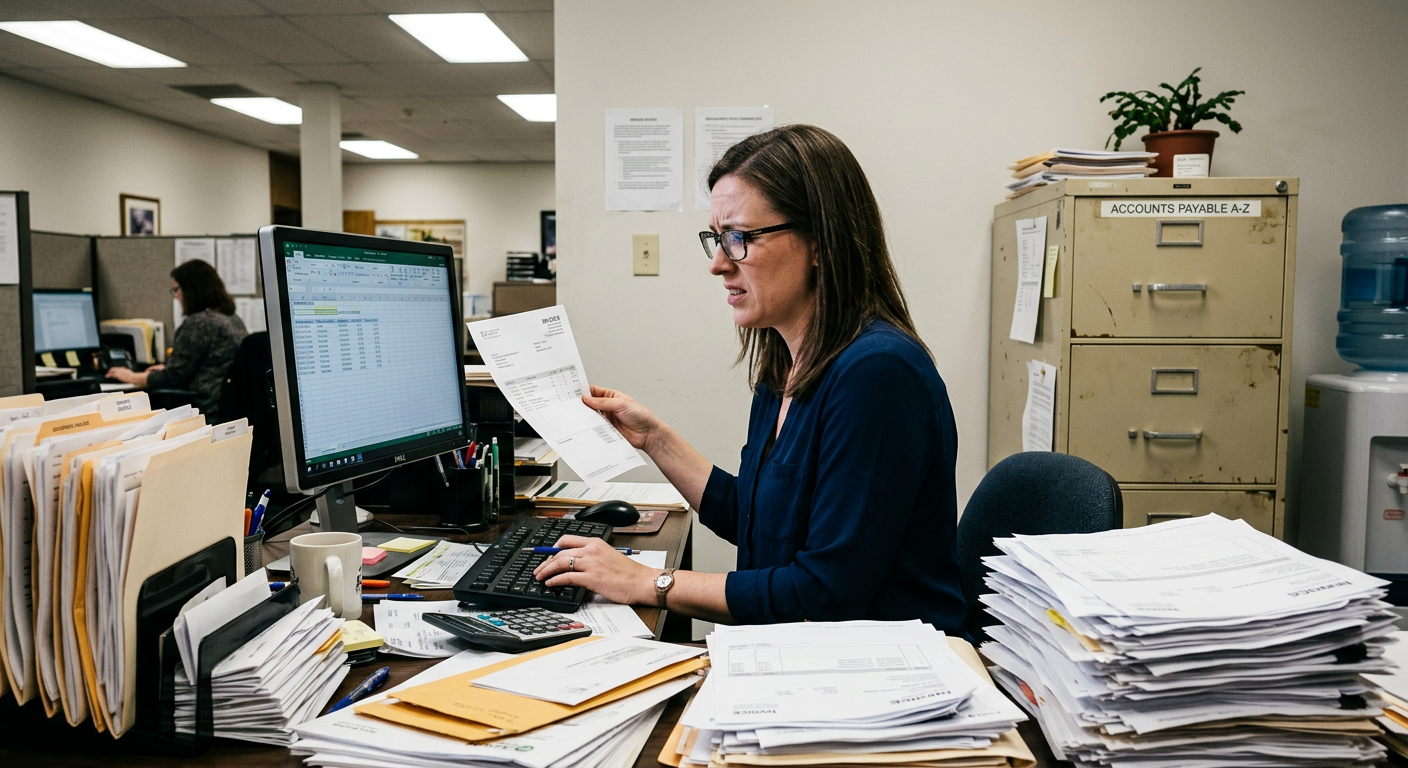
Somewhere in a distribution warehouse right now, an accounts payable clerk is squinting at a PDF invoice on one screen while manually keying line items into an ERP on another. She has 47 more to go before lunch. According to APQC benchmarking data, that manual process costs her employer roughly $15 per invoice, while best-in-class organizations using automation spend just $2.78.
That gap, more than 80%, has existed for years. Yet 68% of AP teams still manually key invoice data into their ERP or accounting software, according to a 2025 Medius survey of finance professionals. For mid-market distributors managing hundreds of vendor relationships across complex product catalogs, the problem is particularly acute. And it is getting more expensive to ignore.
The Real Cost of Manual Invoice Processing in Distribution
Distribution companies occupy a uniquely painful position in the AP landscape. Unlike a SaaS company that might receive a handful of vendor invoices monthly, a mid-market distributor processing electrical components, pharmaceuticals, or food service supplies can easily handle 1,000 to 5,000 invoices per month from dozens or hundreds of suppliers, each with different formats, terms, and line-item structures.
At $15 per invoice, a distributor processing 2,000 invoices monthly spends $360,000 annually on AP processing alone, before accounting for errors, late-payment penalties, or missed early-pay discounts.
Source: APQC benchmarking data via DocuClipper, 2025
The costs extend well beyond labor. Research compiled by DocuClipper found that roughly 39% of invoices contain errors. In distribution, where three-way matching between purchase orders, goods receipts, and invoices is standard practice, each error can cascade into a time-consuming exception that requires manual resolution. A Levvel Research payables survey found that 31% of AP professionals named manual invoice matching among their top pain points.
Late payments compound the problem. Atradius research indicated that only 36% of invoices in the United States were paid on time, with approximately 55% paid after their due date. For distributors who depend on strong supplier relationships to maintain favorable pricing and priority allocation during shortages, chronic late payments erode negotiating leverage in ways that never show up on a balance sheet.
Why Distribution Lags Behind
The AP automation market has been growing rapidly, the global market was valued at $3.08 billion and is projected to grow at a 12.8% compound annual growth rate through 2030, according to Grand View Research. Gartner forecast that spending on AP invoice automation and supplier e-invoicing software would reach nearly $1.75 billion by 2026, up from about $925 million in 2021.
Yet adoption remains uneven. While 65% of large enterprises have implemented automated invoice data entry, 86% of small and medium-sized businesses still manually enter invoice data, according to industry surveys compiled in 2025. The mid-market, where most distributors sit, falls awkwardly in between, often too large for simple accounting tools but lacking the IT resources to implement enterprise AP platforms.
Several distribution-specific factors make the problem harder:
Format fragmentation. A single distributor might receive invoices as emailed PDFs, scanned paper documents, EDI transmissions, and even faxes. Unlike industries that have standardized on e-invoicing, distribution supply chains still run on a patchwork of formats that resist easy automation.
Complex line items. A pharmaceutical distributor's invoice might contain dozens of SKUs with lot numbers, expiration dates, and regulatory compliance codes. An electrical distributor deals with nested part numbers and variable unit-of-measure conversions. These aren't simple "one line, one amount" documents.
ERP diversity. The mid-market distribution sector runs on a wide range of ERP systems, from Epicor and Infor to legacy AS/400 installations that have been customized over decades. Integrating modern AP automation tools with these systems requires careful mapping that many vendors underestimate.
The Three-Way Matching Bottleneck
Three-way matching, the process of reconciling a purchase order, a goods receipt, and a vendor invoice before authorizing payment, is a fundamental control in distribution finance. It prevents overpayment, catches pricing discrepancies, and flags receiving errors. It is also, for most mid-market distributors, an almost entirely manual exercise.
The process typically works like this: an AP clerk receives an invoice, locates the corresponding purchase order in the ERP, checks whether the goods were received and in what quantity, then compares pricing, quantities, and terms across all three documents. Discrepancies, a partial shipment, a price increase, a damaged goods credit, get flagged as exceptions that require further investigation.
For a distributor handling thousands of SKUs across hundreds of vendors, exception rates of 20% to 30% are common. Each exception might take 15 to 30 minutes to resolve, involving phone calls to purchasing, the warehouse, or the vendor. The compounding effect is significant: a distributor processing 2,000 invoices monthly with a 25% exception rate faces 500 exceptions requiring manual intervention every month.
Automated three-way matching systems can reduce this burden dramatically. According to Documation, automated matching can complete reconciliation within minutes of invoice arrival, routing only genuine exceptions to human reviewers. Companies implementing automated matching have reported reducing exception resolution time by 60% to 80%, since the system pre-populates context and flags the specific discrepancy rather than requiring a clerk to investigate from scratch.
What Early Adopters Are Finding
Veckridge Chemical, a family-owned industrial chemical distributor, offers a useful case study. The company had been running a fully manual AP workflow, keying invoices line by line, cutting physical checks, when leadership decided to modernize. After implementing AP automation, the company eliminated manual data entry for the majority of its invoice volume, a shift that freed finance staff to focus on analysis and vendor negotiations rather than paperwork.
A large U.S. members-only wholesale retailer documented by UiPath faced a similar trajectory. The company's AP team had been processing thousands of invoices monthly through manual workflows that were consuming significant staff time. After deploying document understanding and automation technology, the retailer reduced processing time per invoice substantially and redirected those labor hours toward higher-value work.
88% of AP professionals believe that improving invoice management and supplier payments would free their finance team to focus on more strategic initiatives.
Source: Medius 2025 AP Survey
The pattern across early adopters is consistent: the primary return on AP automation is not headcount reduction but capacity reallocation. Distributors that automate invoice processing find their finance teams spending less time on data entry and exception chasing and more time on cash flow management, early-payment discount capture, and vendor relationship optimization.
The AI Acceleration
The latest generation of AP automation tools incorporates AI capabilities that address several of distribution's specific challenges. Modern OCR and machine learning systems can extract data from unstructured invoice PDFs with accuracy rates above 95%, handling the format fragmentation that previously required manual intervention. Natural language processing helps parse complex line-item descriptions and match them against purchase order data even when naming conventions differ between buyer and vendor systems.
Gartner predicted that up to 40% of enterprise applications would include integrated task-specific AI agents by 2026, up from less than 5% in 2025. In accounts payable, these agents can handle invoice intake, data extraction, matching, and routing with minimal human oversight, escalating only genuine anomalies that require judgment.
For distributors, the implications go beyond AP efficiency. Gartner's strategic predictions for 2026 included a forecast that by 2028, 90% of B2B buying would be AI-agent intermediated, pushing over $15 trillion in B2B spend through AI agent exchanges. Distributors that have not automated their own document processing will struggle to participate in an increasingly automated procurement ecosystem.
What Mid-Market Distributors Should Consider
The path from manual invoice processing to automation does not require a massive ERP replacement or a multi-year implementation. Several practical steps can deliver measurable results within months:
Audit the current state. Count invoices by format (PDF, paper, EDI, email), measure average processing time, and calculate the actual cost per invoice including labor, error correction, and late-payment penalties. Most distributors underestimate their true AP costs because the labor is distributed across multiple roles.
Start with high-volume vendors. The Pareto principle applies: a small number of vendors likely account for the majority of invoice volume. Automating intake and matching for the top 20 vendors can capture 60% to 70% of the benefit with a fraction of the implementation effort.
Prioritize ERP integration. The value of AP automation depends entirely on how cleanly it connects to the existing ERP. Any solution that requires manual re-entry at the ERP boundary merely shifts the bottleneck rather than eliminating it.
Measure early-pay discount capture. Many distributor vendor agreements include 1% to 2% discounts for payment within 10 days. Manual processes rarely move fast enough to capture these discounts consistently. Automation can turn missed discounts into a measurable revenue recovery line item.
See how AI fits into your current operations
Get a personalized readiness score in 2 minutes
Take the AssessmentThe Widening Gap
The Business Research Company projected that the global accounts payable automation market would reach $11.8 billion by 2029, growing at 21.5% annually. That growth is being driven by companies that have already made the transition and are now capturing compounding benefits, faster processing, fewer errors, better vendor terms, and finance teams focused on strategy rather than data entry.
For mid-market distributors still processing invoices manually, the competitive gap is widening with each quarter. The $15-per-invoice manual process was tolerable when everyone operated the same way. As automated competitors push their costs below $3 per invoice and their processing times from weeks to hours, the distributors still squinting at PDFs are paying an increasingly steep premium for the status quo.
The invoice PDF problem is not a technology problem. The technology exists, it works, and it pays for itself quickly. It is an inertia problem, and in distribution, inertia has a price tag that grows every month.
Stay ahead of the curve
Get weekly insights on distribution technology and AI automation.
Go Deeper in the Resource Library
Get AI prompts, implementation templates, SOPs, and call scripts built for distribution companies. 47+ resources and growing, free access.
Access the Resource Library, FreeAlso free: Workdshop live sessions for distribution leaders

Never let another sales call go to voicemail.
AI answers every call 24/7, handles routine, escalates what matters. SMS handoff included.
Try the AI Voice Agent