
The Hidden Cost of Managing B2B Orders by Email in 2026

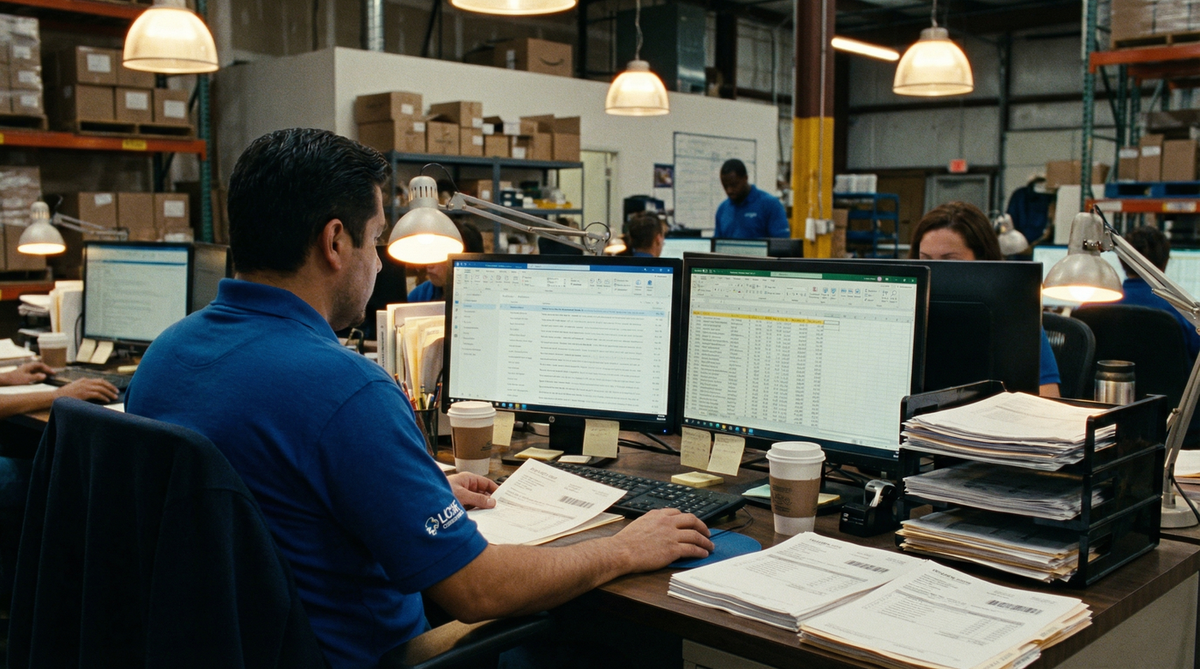
Seventy percent of B2B sales orders are still processed manually. Not in 2015. Not in 2020. In 2025, according to data from Conexiom, seven out of ten business-to-business orders still move through some combination of email, phone calls, fax machines, and spreadsheets before a human types them into an ERP system.
For wholesale distributors, companies whose entire business model depends on moving product from point A to point B with speed and accuracy, that number represents something more than an operational inconvenience. It represents a compounding tax on growth that gets more expensive every year it goes unaddressed.
The $17,800 Mistake
The most frequently cited argument for email-based ordering is that it works. Customers send orders. Staff enters them. Product ships. And most of the time, that's true, most of the time being the operative phrase.
Manual order processing achieves accuracy rates between 95% and 98%, according to research compiled by Zoey, a B2B commerce platform. Automated systems consistently hit 99% or higher. That two-to-five percentage point gap sounds negligible until you apply it to volume.
A mid-market distributor processing 15,000 orders per year at a 97% accuracy rate generates 450 errors annually. Each of those errors, wrong SKU, wrong quantity, wrong shipping address, wrong customer-specific price, triggers a cascade: customer calls, credit memos, return shipping, restocking, reprocessing, and the relationship damage that doesn't show up on any invoice.
B2B order errors cost an average of $17,800 per incident when accounting for delays, inventory disruption, and downstream service failures.
Source: Conexiom / Netguru analysis, 2025
That $17,800 figure, reported by Netguru's 2025 analysis of B2B order management data, includes the full cost chain: the labor to identify the error, the logistics to correct it, the inventory carrying cost of misallocated stock, and the customer service overhead to prevent churn. Multiply 450 errors by even a fraction of that average and the annual cost of "good enough" accuracy runs into seven figures.
The Labor Nobody Talks About
The error cost is dramatic, but the labor cost is relentless. Bizowie, an ERP and distribution technology provider, estimated in a 2025 analysis that a distributor processing 15,000 orders per year spends $200,000 to $350,000 annually in direct labor on manual order entry alone. That figure covers only the time spent typing orders into the system, not the upstream work of reading emails, deciphering handwritten fax orders, calling customers to clarify ambiguous requests, or reconciling mismatches between what was ordered and what was keyed in.
The real cost is opportunity cost. Those order entry hours are being performed by people who could be managing customer relationships, resolving exceptions, or handling the complex orders that actually require human judgment. Instead, they're doing data entry, a task that automation handles faster and more accurately for a fraction of the price.
And the problem extends beyond the back office. According to MarketsandMarkets' 2025 Sales Automation Guide, sales representatives across industries spend only 28% to 30% of their time actually selling. The rest disappears into administrative tasks, and in distribution, a significant chunk of that administrative burden is order-related: chasing confirmations, following up on emailed POs, and manually relaying customer requests to the operations team.
Why It Persists
If email-based ordering is so expensive, why does it persist at 70% adoption? Three reasons, all of them understandable.
Customer inertia. Distributors serve customers who have been emailing orders for a decade. Asking a long-standing account to use a portal or EDI connection feels risky, what if they take their business to a competitor who accepts orders however they want to send them? This fear is rational but increasingly unfounded. B2B buyers are more digitally fluent than ever. The global B2B e-commerce market is projected to reach $36.16 trillion by 2026, according to Coalition Technologies' analysis of market data. Buyers aren't resisting digital ordering, they're already doing it with other vendors.
Field sales resistance. Outside sales reps in distribution have built their workflows around being the conduit between customer and warehouse. They take orders over lunch, at the counter, on the phone, and relay them via email or text to the office. Any system that bypasses that relay threatens their perceived value. The irony is that the relay work is exactly what prevents reps from doing the higher-value work that keeps customers loyal: consultative selling, product recommendations, and strategic account management.
Integration anxiety. Many distributors operate legacy ERP systems that don't connect easily to modern order management tools. The prospect of a six-figure integration project with uncertain timelines is enough to keep the email workflow in place indefinitely, especially when "it works" most of the time.
What the Error Chain Actually Looks Like
Netguru's analysis found that 66% of inventory and fulfillment problems trace back to human error. In a manual email ordering workflow, the error chain typically looks like this:
A customer emails a purchase order as a PDF attachment. A customer service rep opens the PDF, reads line items, and manually enters each into the ERP. If the PDF is formatted differently from the last one, different column order, different product codes, abbreviated descriptions, the rep has to interpret rather than simply transcribe. Interpretation is where errors live.
The wrong SKU gets entered. The warehouse picks the wrong product. The wrong product ships. The customer receives it two days later, calls to complain, and now the return process begins, involving customer service, warehouse receiving, inventory adjustment, re-picking, re-shipping, and a credit memo. One misread line on one PDF attachment has now touched six departments and consumed hours of labor across the organization.
Companies that automate order processing reduce errors by 85%, according to aggregated B2B operations data.
Source: Netguru, 2025
Scale that scenario across a busy distribution center handling hundreds of emailed orders per day and the compound cost becomes staggering, not just in dollars, but in customer trust. The distributor who ships wrong twice doesn't get a third chance.
The Shift Is Happening, Slowly
The distributors who have moved away from email-based ordering report consistent results. Automation platforms, whether built into modern ERP systems, layered on through integration middleware, or handled by purpose-built B2B commerce portals, reduce manual entry by 60% to 80% in most implementations.
Conexiom, which focuses specifically on sales order automation, reports that its clients typically eliminate manual touchpoints on standard orders entirely, freeing customer service staff to handle exceptions, complex orders, and relationship-building activities that email workflows bury under repetitive data entry.
The approach varies by company size and complexity. Smaller distributors, $10 million to $50 million in revenue, often start with a B2B portal that lets customers place orders directly into the system, bypassing email entirely. Larger operations tend to implement document automation that ingests emailed POs and converts them to structured data without human intervention.
Both approaches share a common outcome: the humans who used to type orders now handle the work that actually requires human judgment, and the orders flow faster, more accurately, and at a fraction of the per-order cost.
Is your tech stack keeping up with your operations?
Take our free AI Readiness Assessment
Start AssessmentThe Math That Should End the Debate
For a distributor doing $50 million in annual revenue and processing 20,000 orders per year, the rough math on email-based ordering looks like this:
Direct labor for manual entry: $250,000 to $350,000 per year. Error-related costs at a 3% error rate (600 errors) with even conservative per-incident costs of $2,000: $1.2 million. Customer churn attributable to fulfillment errors, estimated conservatively at 2-3 lost accounts per year: potentially hundreds of thousands in lifetime value.
Against that, a modern order automation implementation typically costs $50,000 to $150,000 upfront with $20,000 to $40,000 in annual licensing, and pays for itself within the first year on labor savings alone, before accounting for error reduction and customer retention.
The gap between what distributors pay to maintain email ordering and what they'd pay to automate it isn't close. It hasn't been close for years. The only thing that changes in 2026 is that the gap gets wider as labor costs rise, customer expectations increase, and the competitors who already automated pull further ahead.
The email inbox was never designed to be an order management system. In 2026, it's time to stop pretending otherwise.
Stay ahead of the curve
Get weekly insights on distribution technology and AI automation.
Go Deeper in the Resource Library
Get AI prompts, implementation templates, SOPs, and call scripts built for distribution companies. 47+ resources and growing, free access.
Access the Resource Library, FreeAlso free: Live virtual training sessions, Thursdays 1 PM ET

Never let another sales call go to voicemail.
AI answers every call 24/7, handles routine, escalates what matters. SMS handoff included.
Try the AI Voice Agent