
Monolithic ERP vs. Best-of-Breed: The Stack Decision Paralyzing Mid-Market Distributors


The global ERP market hit $73 billion in 2025, according to Gartner data compiled by Cargoson, with cloud deployments now representing 70% of all new implementations. Yet for mid-market distributors — companies doing $10 million to $500 million in revenue — the sheer growth of the market has made the fundamental technology question harder, not easier: go all-in on a single ERP platform, or assemble a stack of best-in-class specialized tools?
It is a decision that can lock a company in for five to ten years. And right now, a wave of forced migrations is making thousands of distributors confront it whether they are ready or not.
The Sage Migration Wave Is Forcing the Question
Sage, which leads the ERP market by customer count with 6.1 million users worldwide, has been steadily sunsetting older product versions. As of 2025, Sage 100 version 2022 and earlier lost official support, and the company's broader corporate strategy is pushing users toward cloud platforms like Sage Intacct and Sage X3. For the thousands of mid-market distributors still running Sage 100 — long a workhorse for wholesale and distribution operations — the clock is ticking.
According to SWK Technologies, a Sage implementation partner, 2026 represents a critical decision point. The upcoming Sage 100 v2026 release will require 64-bit Windows systems, effectively ending compatibility for many older server environments. Distributors running legacy hardware now face a compound decision: upgrade the infrastructure to stay on Sage, or use the disruption as an opportunity to rethink the entire stack.
Sage leads ERP customer count with 6.1 million users but generates only $3.1 billion in revenue — a ratio that reflects just how many small and mid-market companies depend on its aging product lines.
This is not a hypothetical scenario. Reddit's r/ERP community has seen a surge of posts from SMB distributors and manufacturers asking variations of the same question: should we migrate to a modern monolithic ERP, or break free and pick the best tool for each job? The debates are heated, detailed, and reveal a market segment genuinely paralyzed by the choice.
The Case for Monolithic ERP
The monolithic ERP pitch is straightforward: one vendor, one database, one support contract. For a distributor managing inventory, order entry, accounts receivable, purchasing, and warehouse operations, having all of those functions share real-time data without integration middleware is a genuine advantage.
Panorama Consulting Group's 2025 ERP Report found that average implementation timelines dropped from 15.5 months to nine months year-over-year, a compression largely attributed to the rise of SaaS-based deployments. Cloud ERP vendors like Oracle NetSuite, Microsoft Dynamics 365 Business Central, and Infor CloudSuite have invested heavily in distribution-specific modules that promise out-of-the-box functionality for wholesale operations.
For distributors in the $10 million to $50 million range, Microsoft Dynamics 365 Business Central has emerged as a popular choice. Its distribution modules handle core workflows — inventory management, sales order processing, warehouse management — while its integration with the broader Microsoft ecosystem (Teams, Power BI, Outlook) reduces the "app switching" that plagues multi-tool environments.
Infor, meanwhile, has doubled down on industry-specific cloud suites. Its CloudSuite Distribution product targets wholesale distributors specifically, with pre-built workflows for demand planning, pricing management, and multi-warehouse operations. Infor's strategy of letting companies start with core ERP and add best-of-breed modules (like Infor WMS or Infor EAM) from its own ecosystem represents a middle path — monolithic architecture with modular expansion.
The Case for Best-of-Breed
The best-of-breed argument is equally compelling on paper. No single ERP does everything well. A distributor with complex warehouse requirements might get better results from a dedicated WMS like Manhattan Associates or Körber than from whatever warehouse module ships with their ERP. A company with sophisticated pricing needs might outgrow ERP-native pricing faster than the vendor can iterate.
The logic extends across the stack: specialized CRM for customer relationships, dedicated e-commerce platforms for B2B ordering, standalone AR automation for collections, and purpose-built analytics for demand forecasting. Each tool, in theory, represents the best available solution for its specific function.
And for companies that already have strong accounting systems — perhaps a solid Sage Intacct or QuickBooks Enterprise deployment — the argument becomes even more pointed. Why rip out something that works just to consolidate onto a platform whose accounting module might be worse than what you already have?
The Integration Tax: What Best-of-Breed Actually Costs
Here is where the best-of-breed argument starts to crack. The industry calls it the "integration tax" — the hidden, compounding cost of making multiple systems talk to each other reliably.
According to a 2025 analysis from Bizowie, integration development typically costs $8,000 to $25,000 per system pair for API development or middleware configuration alone, with an additional $5,000 to $15,000 per integration for data mapping and transformation logic. For a mid-market distributor running seven core systems — a common count that includes ERP, WMS, CRM, e-commerce, EDI, shipping, and pricing — the annual integration maintenance bill runs $40,000 to $120,000.
But the dollar figure understates the operational cost. When an order fails to sync between e-commerce and WMS, shipments get delayed. When inventory counts diverge between accounting and warehouse systems, the reconciliation becomes a manual process. When a vendor pushes an API update that breaks compatibility, someone has to drop everything and fix it.
Integration development costs $8,000–$25,000 per system pair, with annual maintenance of $40,000–$120,000 for a typical multi-tool distribution stack.
Source: Bizowie, 2025
For a $30 million distributor with a four-person IT team, the integration tax is not just a budget line item — it is a strategic constraint. When IT spends 60% of its time keeping integrations alive, there is no bandwidth left for projects that actually move the business forward: automating order entry, building customer self-service portals, or deploying AI for demand forecasting.
The Composable Middle Ground
The ERP market is evolving in a direction that may eventually render the binary choice obsolete. Gartner has been pushing the concept of "composable ERP" since 2022 — the idea that companies should be able to assemble modular capabilities that plug into a shared data layer without the traditional integration overhead.
In practice, this means platforms that expose robust APIs and offer a marketplace of certified extensions. Microsoft's approach with Dynamics 365 is a prime example: companies can start with Business Central for core ERP and layer on Power Platform apps, third-party AppSource extensions, or custom modules — all sharing the same Dataverse database. The integration tax drops because the data layer is unified even though the functional modules are distinct.
Oracle NetSuite has taken a similar path with SuiteApps, its ecosystem of pre-built integrations that extend the platform without requiring custom middleware. For distribution-specific functions like advanced warehouse management or route optimization, SuiteApps offer best-of-breed capabilities within the monolithic data architecture.
The emerging pattern is clear: the winners in mid-market distribution technology will not be purely monolithic or purely best-of-breed. They will be platforms that combine a unified data foundation with the flexibility to swap in specialized capabilities where generic modules fall short.
When Each Approach Actually Wins
After surveying the data and market dynamics, the decision framework for mid-market distributors comes down to a few key variables:
Monolithic ERP wins when: the company is migrating from a legacy system (especially Sage 100 or similar aging platforms), has fewer than 200 employees, needs standard distribution workflows without heavy customization, and values speed of deployment. Panorama's finding that SaaS ERP implementations now average nine months makes this path faster than ever.
Best-of-breed wins when: the company has a genuinely world-class system in one area (like accounting) that would be downgraded by consolidation, operates in a niche with specialized requirements no ERP handles well (like pharmaceutical distribution with strict lot tracking and compliance), or has the IT bench strength to manage ongoing integration work — typically meaning a dedicated integration engineer or a managed services partner.
Composable ERP wins when: the company wants the unified data benefits of monolithic with the flexibility of best-of-breed, is willing to stay within one vendor's ecosystem for core functions, and plans to scale beyond $100 million in revenue where modular expansion becomes essential.
Evaluating your ERP modernization options?
Our ERP Modernization Assessment identifies gaps and priorities
Take the AssessmentThe Real Risk Is Not Choosing
Perhaps the most striking pattern across the Reddit threads, analyst reports, and vendor conversations is how many mid-market distributors are doing nothing. The decision feels so consequential — and the market so noisy — that analysis paralysis has become the default.
That is the most expensive option of all. Every month spent on a system that cannot support AI-driven automation, customer self-service, or real-time analytics is a month of competitive ground lost. The ERP market is projected to reach $81 billion by 2026, according to industry projections based on Gartner data, and cloud-native platforms are adding distribution-specific capabilities at an accelerating pace.
The distributors who will thrive are not the ones who pick the theoretically perfect architecture. They are the ones who pick a direction, commit, and start building on a modern foundation — whether that is a monolithic cloud ERP, a carefully integrated best-of-breed stack, or a composable platform that threads the needle between both.
The only truly wrong answer is to keep running Sage 100 on a Windows Server 2016 box in the back office and hope the problem solves itself.
Stay ahead of the curve
Get weekly insights on distribution technology and AI automation.
Go Deeper in the Resource Library
Get AI prompts, implementation templates, SOPs, and call scripts built for distribution companies. 47+ resources and growing — free access.
Access the Resource Library — FreeAlso free: Live virtual training sessions — Thursdays 1 PM ET
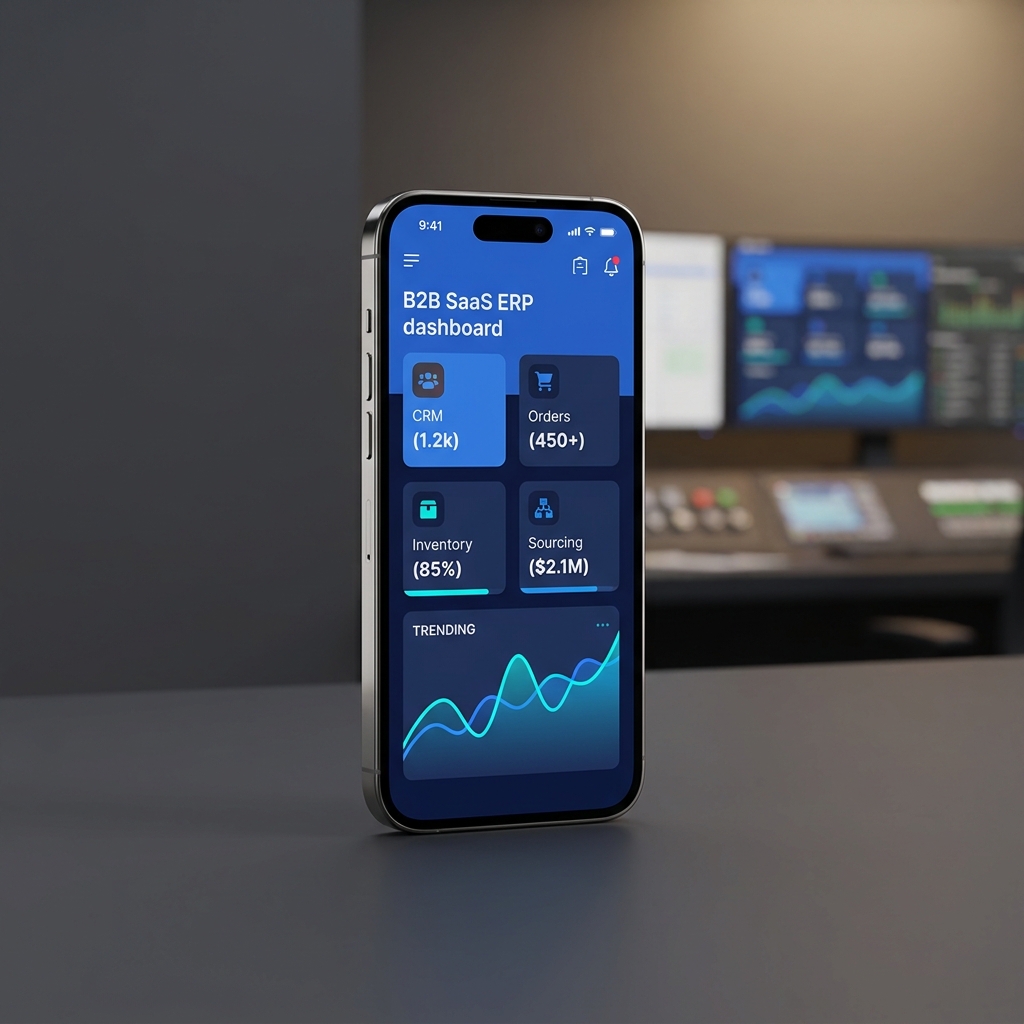
You don't have to replace your ERP.
Workd is modular — start with one module and expand at your pace. Sits next to Epicor, NetSuite, SAP, Sage.
Free ERP Modernization Assessment