
Energy Costs Are Eating Manufacturing Margins, How Smart Grid Integration Is Fighting Back

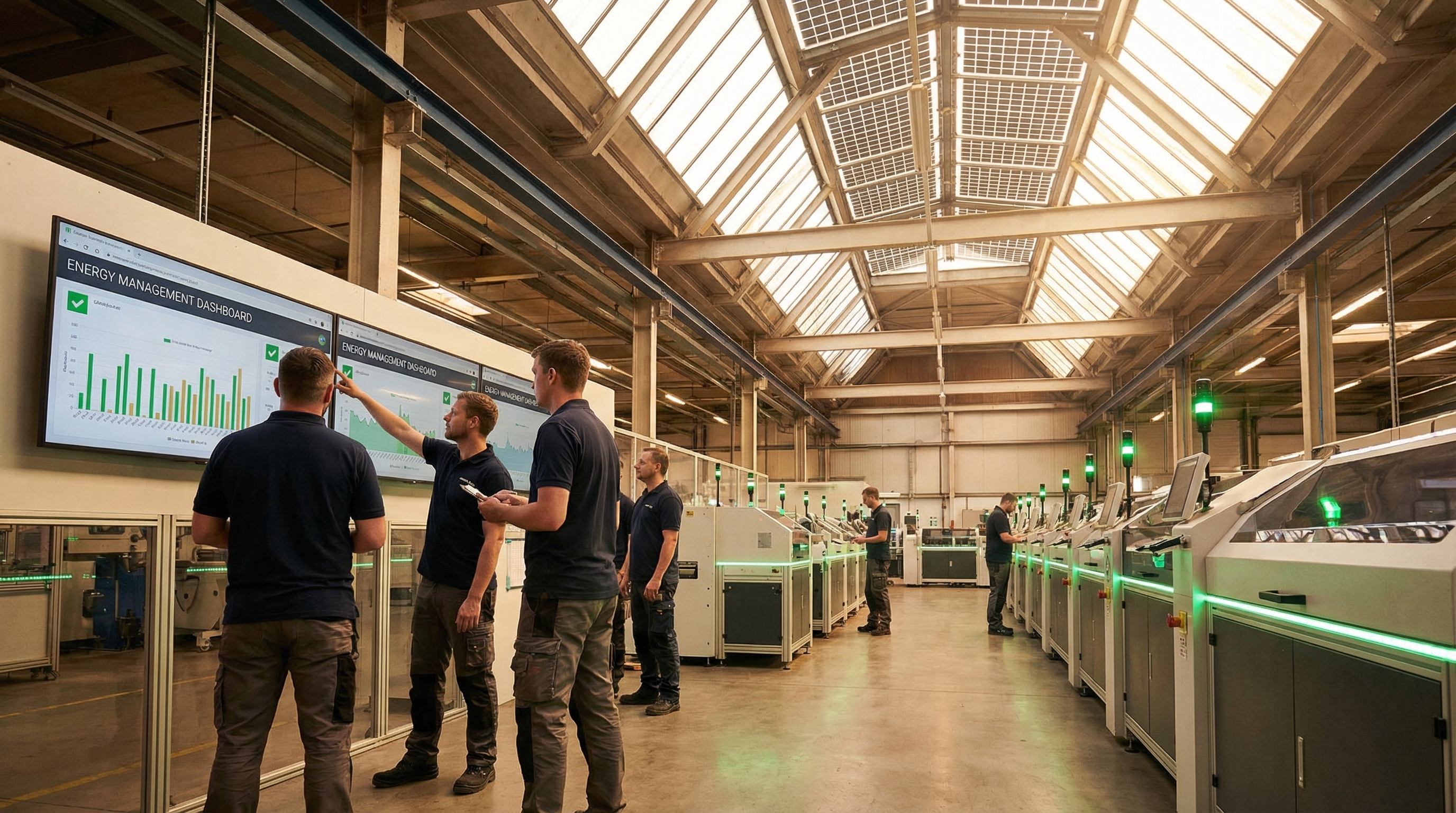
Industrial electricity in the United States now averages 8.62 cents per kilowatt-hour, according to the U.S. Energy Information Administration's latest data, a 25% increase from the 6.67 cents manufacturers paid in 2020. For a mid-market factory running three shifts, that translates to hundreds of thousands of dollars in additional annual cost that didn't exist five years ago. And the trajectory isn't flattening: the EIA's 2025 Annual Energy Outlook projects industrial rates rising another 7% through 2027.
Manufacturers already operate on thin margins. Deloitte's 2025 Manufacturing Industry Outlook noted that while the purchasing managers' index briefly entered expansion territory in early 2024, weaker demand pushed it back into contraction by mid-year. Total compensation costs continue climbing. Input material prices have stabilized but remain elevated. Energy, the one variable cost that compounds across every production line, every warehouse, every refrigeration unit, is now the margin item that separates profitable operations from struggling ones.
The response taking shape isn't conservation for its own sake. It's a coordinated technology shift toward smart grid integration, demand response participation, and distributed energy resources that collectively give manufacturers control over a cost category they've historically just absorbed.
The Math Behind the Margin Squeeze
Energy typically accounts for 15-25% of a manufacturer's total operating costs, though in energy-intensive sectors like chemicals, metals, and glass, that figure reaches 35% or higher. When electricity prices rise 25% over five years against manufacturing margins already compressed to 5-15%, the arithmetic is straightforward: every unmanaged kilowatt-hour erodes profitability.
Industrial electricity prices rose from 6.67¢/kWh in 2020 to 8.62¢/kWh in 2025, a 29% increase in five years.
, U.S. Energy Information Administration, Electric Power Monthly, December 2025
The problem isn't just the rate per kWh. Demand charges, fees based on peak electricity consumption during billing periods, can represent 30-50% of a manufacturer's total electric bill. A single high-consumption spike during a 15-minute interval can inflate the demand charge for an entire month. Most mid-market manufacturers lack the real-time visibility to identify these spikes, much less prevent them.
An International Energy Agency survey of 1,000 industrial facilities worldwide, published in 2025, found that 70% of respondents who had invested in energy efficiency measures reported a return on investment exceeding 10%. The money is there. The gap is in execution: knowing where the waste happens, when peak loads occur, and which equipment to curtail without disrupting production.
Smart Grid Integration: From Passive Consumption to Active Management
Smart grid technology gives manufacturers bidirectional communication with their utility providers and, critically, real-time visibility into their own energy consumption patterns. The shift from a monthly utility bill, essentially a rearview mirror, to continuous monitoring changes the entire cost structure.
Schneider Electric deployed its EcoStruxure platform across its own global supply chain as a proof point. Across its Smart Factories and Smart Distribution Centers, the company reported energy cost reductions between 10% and 30%, along with significant maintenance cost decreases. The platform combines IoT sensors on equipment, machine learning for consumption forecasting, and automated controls that adjust energy use in response to grid signals.
For mid-market manufacturers that can't build Schneider-scale infrastructure, the relevant development is the commoditization of these tools. IoT energy monitors from companies like Sense, Eniscope, and Powerit Solutions now cost a fraction of what industrial energy management systems did five years ago. A facility can instrument its major energy consumers, compressors, HVAC systems, lighting, production lines, for $20,000-$50,000 and begin identifying waste patterns within weeks.
70% of industrial facilities that invested in energy efficiency reported ROI exceeding 10%.
, International Energy Agency, 2025 Industrial Facilities Survey
The real value emerges when monitoring connects to automated response. Smart building management systems can pre-cool a facility during off-peak hours, ramp down non-critical loads when demand charges approach threshold levels, and coordinate equipment startup sequences to avoid simultaneous power draws that trigger peak pricing.
Demand Response: Getting Paid to Use Less
Demand response programs offer manufacturers direct revenue for reducing electricity consumption during grid stress events. It's one of the few energy strategies that puts money back into a manufacturer's pocket rather than just reducing outflows.
The Federal Energy Regulatory Commission's December 2025 staff report documented that demand response participation in wholesale markets increased by approximately 217 MW in 2024. Grand View Research estimates the industrial segment of the smart demand response market is growing at 18.3% annually, the fastest of any sector. FERC Order 745, which requires demand response resources to be compensated at the same rate as generation resources in wholesale markets, made industrial participation financially viable at scale.
In practice, a manufacturer enrolled in a demand response program receives advance notice, typically 30 minutes to two hours, of a curtailment event and agrees to reduce consumption by a specified amount. The reduction might involve temporarily powering down a batch process, switching to backup generation, or deferring energy-intensive operations like heat treating or coating to a later window. In return, the manufacturer receives capacity payments and, during actual curtailment events, energy payments that can total tens of thousands of dollars annually.
The California Energy Commission committed $17 million to an industrial demand flexibility hub through Lawrence Berkeley National Laboratory, specifically targeting manufacturing and agricultural facilities for demand response demonstrations. The investment reflects a broader recognition that industrial loads represent untapped flexibility the grid increasingly needs as renewable penetration grows and peak demand patterns shift.
See how much revenue you're leaving on the table
Take our 2-minute Revenue Leakage Assessment and identify hidden operational costs.
Start AssessmentOn-Site Generation: Owning the Supply
The economics of on-site solar generation have crossed a threshold that makes rooftop and ground-mount installations viable for facilities well below utility scale. The Solar Energy Industries Association reported that U.S. module manufacturing capacity grew more than 50% in 2025, reaching 65.5 GW, up from 42.5 GW at the end of 2024. That domestic capacity expansion, combined with Inflation Reduction Act manufacturing credits, has pushed commercial solar costs to levels where a warehouse or factory roof becomes a producing asset rather than dead space.
The combination of on-site generation with battery energy storage creates a more powerful economic tool. Lithium iron phosphate (LFP) battery cells for stationary storage applications dropped to approximately $40/kWh in late 2025, according to Ember's analysis of market pricing. Full commercial battery systems, including cells, battery management, power conversion, and installation, now range from $280-$580/kWh. For a manufacturer facing $100,000+ in annual demand charges, a battery system that shaves peak loads can pay for itself in three to five years while simultaneously providing backup power during outages.
The strategy is additive. Solar offsets baseline consumption during daylight hours. Batteries store excess generation and discharge during peak pricing windows. Smart controls coordinate the entire system with grid signals and production schedules. Each layer independently reduces energy costs; together, they compound.
The Automation Layer: Where AI Ties It Together
Energy management in isolation is a facilities problem. Energy management integrated with production scheduling, inventory planning, and equipment maintenance is an operations advantage.
AI-powered energy management platforms can now correlate production data with energy consumption in real time, identifying which product runs consume disproportionate energy, which shifts operate least efficiently, and which equipment is degrading toward failure based on its energy signature. That analysis turns energy from a fixed overhead into a variable that operations teams can optimize alongside throughput, quality, and delivery performance.
For distribution operations specifically, where warehouse climate control, conveyor systems, and fleet charging represent growing energy loads, the same principles apply at a different scale. A distribution center that times its battery charging, adjusts cold storage temperatures in narrow bands, and participates in demand response during summer peaks can materially reduce per-unit fulfillment costs without touching service levels.
The manufacturers and distributors gaining an edge aren't waiting for energy prices to stabilize. They're instrumenting their facilities, enrolling in demand response programs, evaluating on-site generation, and connecting those systems through intelligent controls. The IEA data shows the ROI is real. The FERC data shows the grid incentives are growing. The EIA data shows the cost pressure isn't going away.
What to Watch in 2026
Three developments will shape the energy cost equation for manufacturers this year. First, the continued buildout of domestic battery manufacturing under IRA incentives should further compress storage costs, making demand charge management accessible to smaller facilities. Second, FERC's ongoing proceedings on distributed energy resource aggregation could open new revenue streams for manufacturers with on-site generation and storage. Third, the maturation of AI-driven building management systems means the gap between monitoring energy and optimizing it in real time is closing fast.
Manufacturers operating on 5-15% margins don't have the luxury of absorbing another 7% electricity price increase. The technology to manage that exposure exists, the payback periods are measured in years rather than decades, and the early movers are already seeing results. The question for the rest isn't whether smart grid integration makes sense, it's how long they can afford to run without it.
Stay ahead of the curve
Get weekly insights on distribution technology and AI automation.
Where does your business stand on AI?
Take the free AI Readiness Assessment, a 5-minute scorecard with personalized recommendations.
Start the Assessment