
Energy Costs Are Eating Manufacturing Margins — How Smart Grid Integration Is Fighting Back

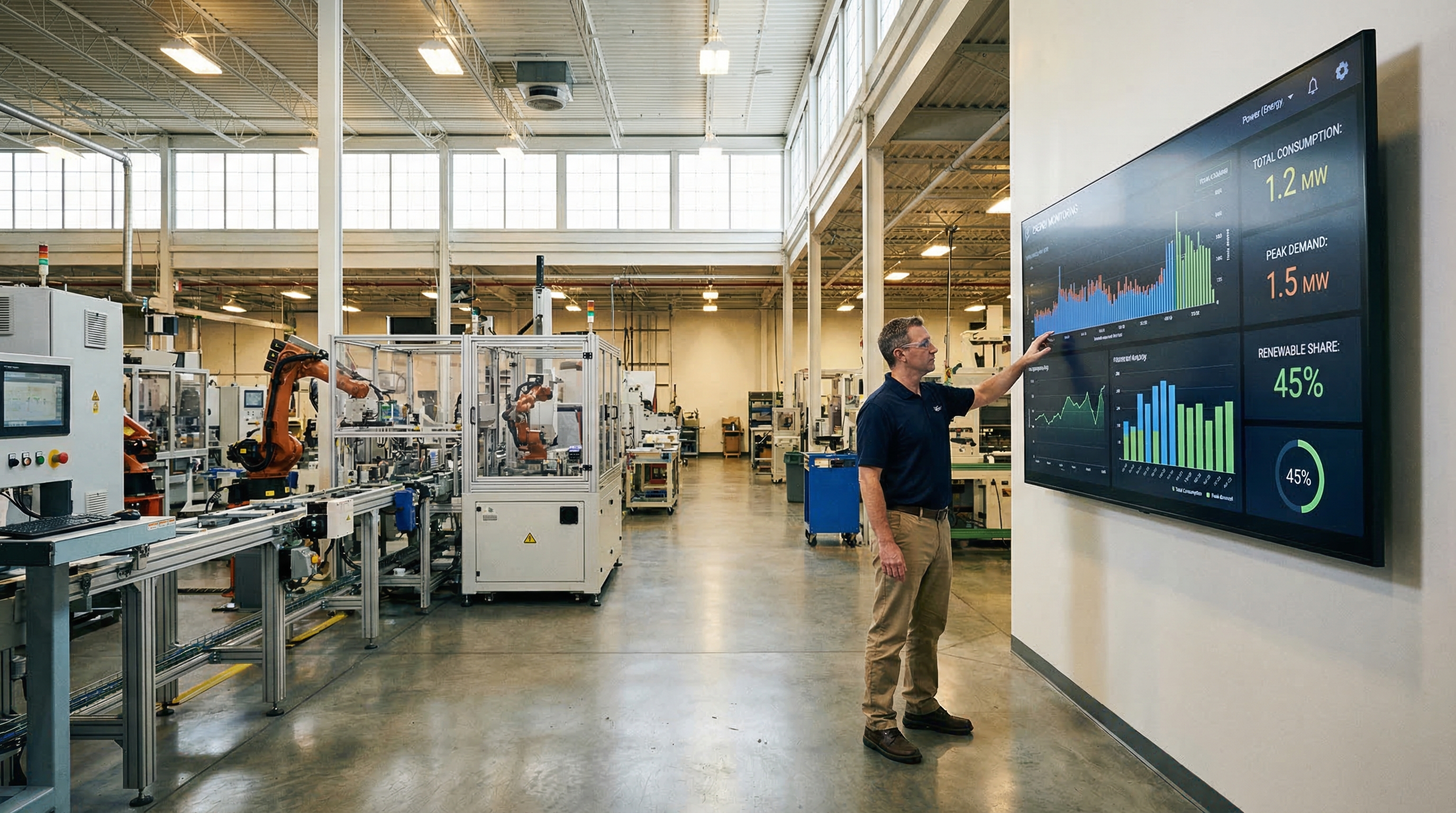
U.S. industrial electricity prices climbed 7.2% in December 2025 compared to the prior year, according to the Energy Information Administration — and projections suggest another 7% increase through 2026. For manufacturers already operating on margins compressed to 5–15%, energy costs that consume 20–35% of operating budgets have moved from line item to existential threat.
The response is not to absorb the hit. A growing cohort of manufacturers is integrating smart grid technology, enrolling in demand response programs, and deploying AI-powered energy management systems to claw back margin points that the utility bill is taking away. The industrial energy management systems market, valued at $36 billion in 2024, is projected to reach $70.6 billion by 2030, growing at 11.9% annually, according to Research and Markets — a pace that signals an industry in the middle of a structural shift, not a trend.
The Math That Forced the Conversation
Energy has always been a cost center in manufacturing. What changed is the speed at which it's growing relative to everything else. The EIA's Electric Power Monthly data shows industrial electricity prices have risen faster than the Consumer Price Index for three consecutive years. For a mid-size manufacturer running $50 million in annual revenue with energy at 25% of operating costs, a 7% price increase translates to roughly $875,000 in additional annual expense — money that comes directly off the bottom line.
Manufacturing margins are compressed to 5–15%, with energy costs projected to rise another 7% in 2026. For many mid-market operators, the margin between profitability and loss now runs through the electrical panel.
The problem compounds for energy-intensive verticals. Steel production, chemical processing, food manufacturing, and plastics molding all carry energy loads well above the 20–35% average. Nucor, the largest U.S. steelmaker, has responded by producing its Econiq steel line using 100% renewable energy sources and investing in next-generation nuclear through a partnership with NuScale — strategies that only make sense when energy costs are large enough to justify capital-intensive alternatives.
Smart Grid Integration: What It Actually Means on the Factory Floor
Smart grid integration in a manufacturing context is not a single technology. It's a stack of interconnected systems: advanced metering infrastructure (AMI) that provides granular, real-time consumption data; automated demand response controllers that can shed non-critical loads during peak pricing windows; energy storage systems that charge during off-peak hours and discharge when rates spike; and predictive analytics platforms that forecast consumption patterns against utility rate structures.
Schneider Electric's EcoStruxure platform, Siemens' Industrial Edge energy applications, and Honeywell's Forge Energy Optimization each represent enterprise-grade implementations of this stack. Schneider, in particular, has pushed aggressively into AI-powered demand-side management in industrial settings, deploying systems that autonomously adjust HVAC, compressed air, and auxiliary motor loads in response to real-time grid pricing signals.
The practical impact: a facility running Schneider's platform can reduce peak demand charges by 15–20% without touching production schedules. The system identifies which loads are flexible — cooling towers, air compressors running at partial capacity, lighting in unoccupied zones — and curtails them during the 15-minute intervals that determine demand charges on most industrial rate schedules.
Demand Response Programs: Getting Paid to Use Less
Demand response flips the energy cost equation. Instead of only paying the utility, manufacturers can earn revenue by agreeing to reduce consumption during grid stress events. The programs are administered by utilities, independent system operators (ISOs), and third-party aggregators like CPower and EnergyHub.
The International Energy Agency reported that global demand response capacity reached 200 GW in 2024, with industrial participants accounting for the largest share of curtailable load. In the U.S., PJM Interconnection — the regional transmission organization covering 13 states and 65 million people — paid demand response participants over $1 billion in capacity payments during the 2024/2025 delivery year.
In India, Tata Power launched a demand response program targeting 6,000 large commercial and industrial consumers, aiming for 200 MW of peak reduction by 2025 — evidence that the model scales globally, not just in deregulated U.S. markets.
For manufacturers, participation typically means allowing automated systems to reduce non-essential loads for 1–4 hours during extreme heat events, polar vortex conditions, or other grid emergencies. The payment structures vary — some programs pay annual capacity fees regardless of whether curtailment events occur, while others compensate per-event. Either way, the economics are compelling: industrial facilities with flexible loads can earn $50,000 to $500,000 annually depending on size and curtailment capacity.
Battery Storage: The Peak-Shaving Multiplier
Battery energy storage systems (BESS) have crossed the cost threshold where peak shaving delivers clear payback for industrial facilities. The principle is straightforward: charge batteries during off-peak hours when electricity costs $0.04–0.06 per kWh, then discharge during peak windows when rates hit $0.15–0.25 per kWh. The arbitrage covers the capital cost of the battery system within 4–7 years, with 15–20 year expected lifespans on modern lithium iron phosphate (LFP) cells.
The real value often comes from demand charge reduction, not energy arbitrage. Many industrial rate schedules set demand charges based on the single highest 15-minute consumption interval in a billing period. A manufacturing facility that spikes to 2 MW during a production ramp-up but averages 1.2 MW pays demand charges on the full 2 MW — every month. A BESS sized to shave that peak can reduce demand charges by 30–40%, often delivering payback faster than the arbitrage use case alone.
Lawrence Berkeley National Laboratory's Industrial Demand Flexibility Hub, funded by a $17 million California Energy Commission grant, is conducting demonstrations at manufacturing, food processing, and distribution sites to quantify exactly how much flexibility industrial facilities can provide through storage-plus-controls configurations. The findings, expected through 2026, will likely establish benchmarks that accelerate adoption across the sector.
AI Ties the System Together
The common thread across smart grid integration, demand response, and battery storage is data — and the AI systems that turn that data into autonomous decisions. A modern industrial energy management platform ingests thousands of data points per minute: utility rate signals, weather forecasts, production schedules, equipment operating states, battery charge levels, and grid operator curtailment notifications.
McKinsey's 2025 State of AI report found that 80% of companies set efficiency as an objective of their AI initiatives, with manufacturing among the sectors seeing the highest return on AI investment. In energy management specifically, AI enables predictive load scheduling — shifting discretionary processes like batch heating, water treatment, or raw material pre-conditioning to hours when rates are lowest, without disrupting production flow.
See how much revenue you're leaving on the table
Take our 2-minute Revenue Leakage Assessment
Start AssessmentSiemens' Industrial Edge platform takes this further by running energy optimization models directly on factory-floor hardware, avoiding the latency of cloud-based systems. The edge deployment means the system can respond to a demand response curtailment signal and begin shedding loads within seconds — a requirement for participation in fast-response frequency regulation markets that pay premium rates.
On-Site Generation: The Long-Term Play
For manufacturers with large roof footprints or adjacent land, on-site solar paired with battery storage is becoming the structural hedge against utility rate volatility. Commercial solar costs have fallen 70% over the past decade, and the Investment Tax Credit (ITC) — extended through the Inflation Reduction Act — provides a 30% credit on installed cost for systems that meet domestic content and prevailing wage requirements.
The economics are most favorable in states with high industrial electricity rates — California, Connecticut, Massachusetts, New York — but the calculus is shifting as utility rates climb nationally. A 500 kW rooftop solar installation on a manufacturing facility in Michigan, for example, now pencils out at a 5–6 year payback with the ITC, generating electricity at roughly $0.04 per kWh against a utility rate of $0.10–0.12. Over a 25-year panel lifespan, that's millions in avoided energy cost.
Nucor's approach represents the industrial end of this spectrum. The company produces steel using energy from 100% renewable sources at select facilities and has invested in small modular nuclear reactors through its NuScale partnership — a bet that zero-carbon baseload power will eventually cost less than grid electricity for continuous industrial operations.
What Mid-Market Manufacturers Should Do Now
The gap between manufacturers who treat energy as a fixed cost and those who manage it as an optimizable variable is widening. The entry points are more accessible than the Nucor-scale examples suggest:
Start with visibility. Advanced metering — sub-metering individual production lines, HVAC systems, and compressed air networks — costs $10,000–50,000 depending on facility size and reveals where energy is being wasted. Most facilities find 10–15% in immediate savings from eliminating phantom loads, fixing compressed air leaks, and adjusting HVAC schedules.
Enroll in demand response. Participation requires minimal capital investment — often just a smart thermostat or automated load controller provided by the utility or aggregator. The revenue alone justifies the effort, and the data from participation reveals consumption patterns that inform larger investments.
Evaluate battery storage for peak shaving. Facilities paying demand charges above $15 per kW-month — common on industrial rate schedules — should model BESS economics. With federal tax credits and declining battery costs, the payback calculus improves every quarter.
Build toward integrated energy management. The full stack — AMI, demand response, storage, on-site generation, and AI-driven optimization — doesn't need to deploy all at once. Each layer generates standalone ROI while creating the data foundation for the next.
The industrial energy management systems market is projected to grow from $36 billion to $70.6 billion by 2030. The manufacturers investing now are building a structural cost advantage that compounds every year utility rates climb.
The manufacturers who wait for energy costs to stabilize are making a bet against the data. Grid infrastructure investment, data center demand from AI workloads, electrification of transportation, and the retirement of legacy generation assets all point in one direction. The question is not whether energy costs will keep rising, but which manufacturers will have built the systems to absorb the increases — and which will watch their margins disappear into the utility bill.

Where does your business stand on AI?
Take the free AI Readiness Assessment — a 5-minute scorecard with personalized recommendations.
Start the AssessmentStay ahead of the curve
Get weekly insights on distribution technology and AI automation.