
What a Mission Control Dashboard Actually Looks Like for a $20M Distributor

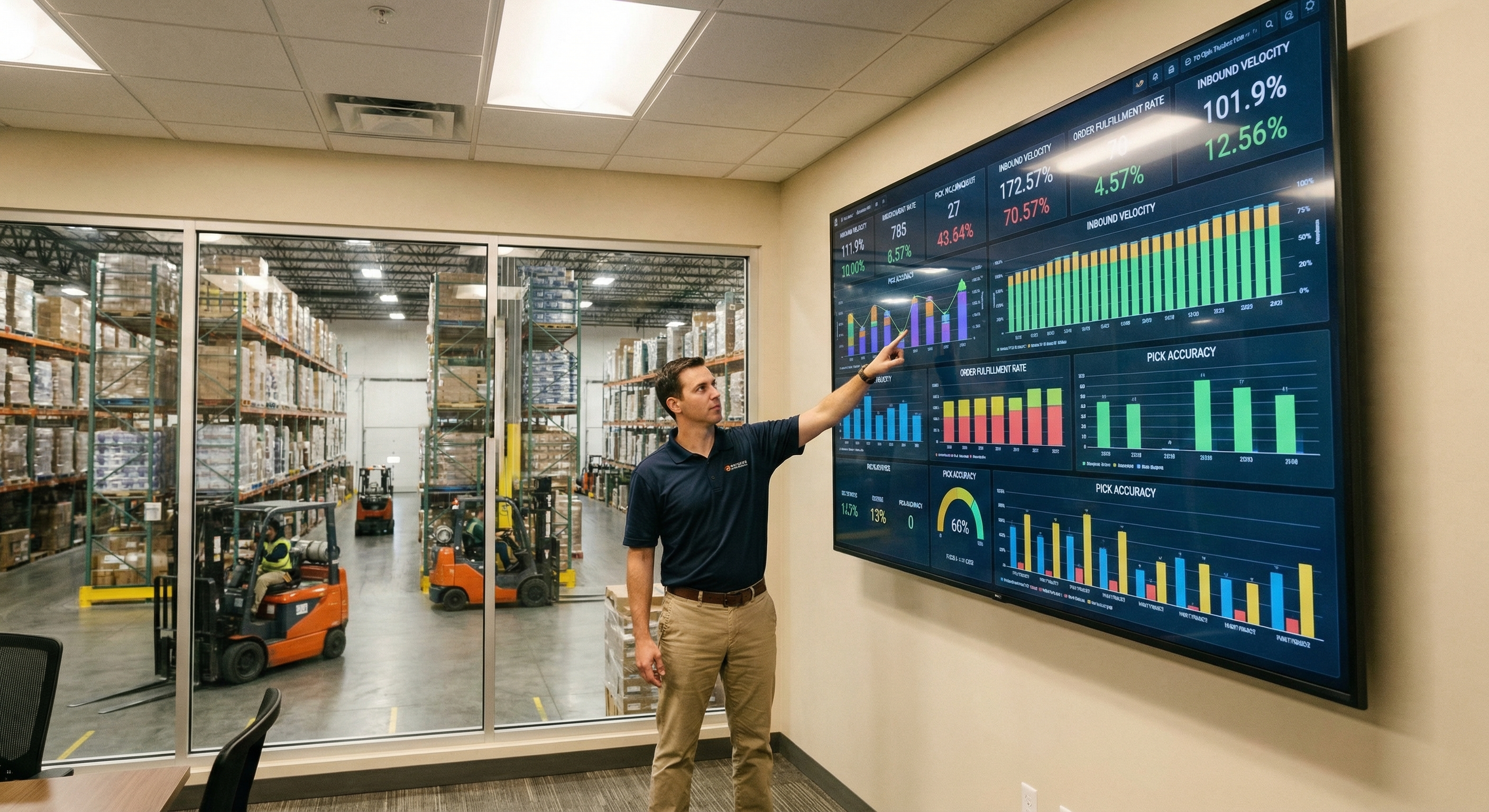
A $20 million electrical distributor in Ohio discovered last year that 14% of its orders shipped with at least one line-item error. Not because the warehouse team was careless — because nobody had visibility into the problem until a quarterly review surfaced months of customer complaints. The data existed across three systems. Nobody had stitched it together.
That gap — between data that exists and data that's actionable — defines most mid-market distribution companies today. The information to run a tighter operation is already sitting in ERP databases, warehouse management systems, CRM platforms, and accounting software. The problem isn't data scarcity. It's data fragmentation.
According to a McKinsey Global Institute study, data-driven organizations are 23 times more likely to acquire customers and 19 times more likely to be profitable. Yet for most distributors under $100 million in revenue, "data-driven" still means someone pulling a report from the ERP on Thursday afternoon and emailing it to the leadership team.
A mission control dashboard changes that equation. Here's what one actually looks like when built for a mid-market distributor — not a Fortune 500 logistics operation, not a Silicon Valley startup, but a $20 million company with 40 employees, two warehouses, and an ERP system that predates the iPhone.
The Four Data Streams That Matter
Enterprise dashboards tend to drown users in metrics. A distribution command center needs exactly four data streams feeding into a single view, each answering a specific operational question.
Stream 1: Order Flow. How many orders came in today, how many shipped, and where are the bottlenecks? This pulls from the ERP's sales order module and the warehouse management system. The critical metrics here aren't total order volume — they're cycle time (hours from order entry to shipment), pick accuracy rate, and backorder percentage. Industry benchmarks from InsightSoftware's 2025 distribution KPI report put best-in-class fill rates above 97%. Most mid-market distributors hover around 92-94%.
Stream 2: Inventory Health. What's overstocked, what's trending toward stockout, and what's sitting dead? This pulls inventory levels against velocity data — not just what's on the shelf, but how fast it moves. The metric that matters most is days of supply by SKU category, cross-referenced against carrying cost. Distribution industry data from Bizowie shows that top performers maintain 98% inventory accuracy through continuous cycle counting. Many mid-market operations run closer to 90%.
Stream 3: Receivables and Cash. Who owes money, how old is it, and what's the collection trajectory? This feed comes from the accounting system and is arguably the most underrated dashboard component. For a $20 million distributor, every day of DSO (days sales outstanding) improvement frees up roughly $55,000 in working capital. The dashboard should flag accounts trending past terms before they become write-off candidates.
Stream 4: Sales Activity. What's the pipeline doing, where are reps spending time, and which accounts are going quiet? CRM data — call logs, quote activity, account engagement scores — feeds this stream. The goal isn't surveillance. It's pattern detection: identifying accounts that haven't ordered in 30 days, flagging margin erosion on repeat orders, and surfacing cross-sell opportunities based on purchasing patterns.
92% of wholesale distribution firms now use ERP software, but fewer than 30% have unified their operational data into a single command view. — Anchor Group / BluLink ERP, 2025
What AI Does With All That Data
A static dashboard — even a well-designed one — is just a better spreadsheet. The shift happening now is from dashboards that display information to dashboards that interpret it.
Gartner predicted in June 2025 that AI agents will augment or automate 50% of business decisions by 2027. In distribution, that prediction is already playing out in specific, narrow use cases.
Pattern detection is the first layer. An AI-augmented dashboard doesn't just show that fill rates dropped to 91% last Tuesday — it correlates that drop with a vendor shipment delay, identifies the 12 SKUs affected, and calculates the revenue impact of unfilled orders. It connects dots that a human analyst could connect given enough time, but does it in seconds rather than days.
Anomaly alerting is the second layer. Instead of reviewing KPIs on a weekly cadence, the system pushes notifications when something deviates from established patterns. A customer that normally orders $8,000 per month dropping to $3,000. A product category where margins contracted 200 basis points over six weeks. A warehouse zone where pick errors tripled after a shift change. These aren't insights a manager would catch glancing at a dashboard — they're the kind of slow-moving signals that become expensive problems by the time they surface in traditional reviews.
Recommendation engines form the third layer. Based on historical patterns, an AI layer can suggest reorder points, flag customers for proactive outreach, or recommend pricing adjustments on slow-moving inventory. Aera Technology's research on decision intelligence platforms notes that adoption sits at 5-20% today, with mainstream maturity expected within two to five years — meaning early adopters in distribution have a concrete window of advantage.
See how much revenue you're leaving on the table
Take our 2-minute Revenue Leakage Assessment
Start AssessmentFrom Reactive Firefighting to Proactive Management
The operational difference between a distributor with a mission control dashboard and one without comes down to response time. Not server response time — organizational response time.
Consider a common scenario: a key supplier announces a 6% price increase effective in 30 days. At a distributor without centralized visibility, that information lands in a purchasing manager's inbox. They forward it to sales leadership. Someone eventually updates the pricing matrix in the ERP. Reps may or may not learn about it before quoting existing customers. Some orders ship at the old margin for weeks.
At a distributor with a command center, the price change triggers an automated workflow. The dashboard immediately surfaces every open quote, pending order, and contract renewal that includes affected products. It calculates the margin impact across the current book of business. It flags the 15 customers most affected by the change, ranked by volume, so the sales team can have proactive conversations rather than apologetic ones.
McKinsey's research on data-driven commercial growth found that organizations using this kind of connected intelligence report EBITDA improvements of 15-25%, achieved through a combination of sales growth and margin protection over several years. For a $20 million distributor operating on typical wholesale margins of 20-25%, even a modest 2-point EBITDA improvement represents $400,000 in annual earnings.
What This Actually Costs
The enterprise business intelligence market loves to sell six-figure implementations with 18-month timelines. For a $20 million distributor, that's neither realistic nor necessary.
A practical command center implementation breaks into three tiers:
Tier 1: Unified Reporting ($500-$2,000/month). Connect ERP, WMS, and accounting data into a single BI tool — Power BI, Looker, or a distribution-specific platform like Phocas. This gets the four data streams into one view with automated refresh. Most implementations take 4-8 weeks. No AI, no automation — just visibility.
Tier 2: Alerting and Automation ($2,000-$5,000/month). Add anomaly detection, threshold-based alerts, and basic workflow triggers. When DSO exceeds 45 days on an account, auto-generate a collection task. When inventory drops below safety stock, auto-create a PO draft. This layer connects the dashboard to action and typically requires 2-3 months of configuration.
Tier 3: AI-Augmented Intelligence ($5,000-$15,000/month). Layer in predictive analytics, recommendation engines, and natural-language querying. Ask the dashboard "which customers are at risk of churning?" and get an answer based on order pattern analysis, not gut feel. This tier is where the 15-25% EBITDA gains materialize, but it requires clean historical data and organizational commitment to act on what the system surfaces.
The total cost for a fully built-out command center at a $20 million distributor ranges from $60,000 to $180,000 per year — roughly 0.3-0.9% of revenue. Against a potential $400,000+ annual earnings improvement, the payback period typically falls under 12 months.
Digital transformation adoption in sales reached 68% among mid-sized firms by 2024, correlating with a 28% faster sales cycle. — Gitnux Market Data, 2026
Implementation: Start With One Screen
The distributors that succeed with operations dashboards don't try to build the whole command center at once. They start with one screen — literally one monitor in the operations area — showing the metrics that cause the most pain today.
For most, that's order fulfillment: orders in, orders picked, orders shipped, exceptions. A single screen that the warehouse manager, the sales director, and the owner can all glance at and immediately understand whether today is going well or going sideways.
From there, expansion follows the pain. If AR collections are a recurring problem, add the receivables stream. If inventory write-offs are eating margin, add the inventory health view. Each addition takes weeks, not months, because the data infrastructure built for stream one supports the rest.
The critical mistake to avoid: building a dashboard nobody looks at. The most effective implementations put screens in high-traffic areas — the warehouse floor, the break room, the sales bullpen — and tie daily standups to what the dashboard shows. When a fill rate number turns red, someone owns it by end of day. When DSO ticks up, collections activity starts that week.
The $7 trillion U.S. wholesale distribution industry, as quantified by the National Association of Wholesaler-Distributors, runs on relationships, inventory, and information. The first two haven't changed in a century. The third is changing faster than most mid-market distributors realize — and the gap between those who see their operation clearly and those who don't is widening every quarter.

Never let another sales call go to voicemail.
AI answers every call 24/7, handles routine, escalates what matters. SMS handoff included.
Try the AI Voice AgentStay ahead of the curve
Get weekly insights on distribution technology and AI automation.