
Digital Twins Hit the Job Site: How Construction Firms Are Simulating Builds Before Breaking Ground

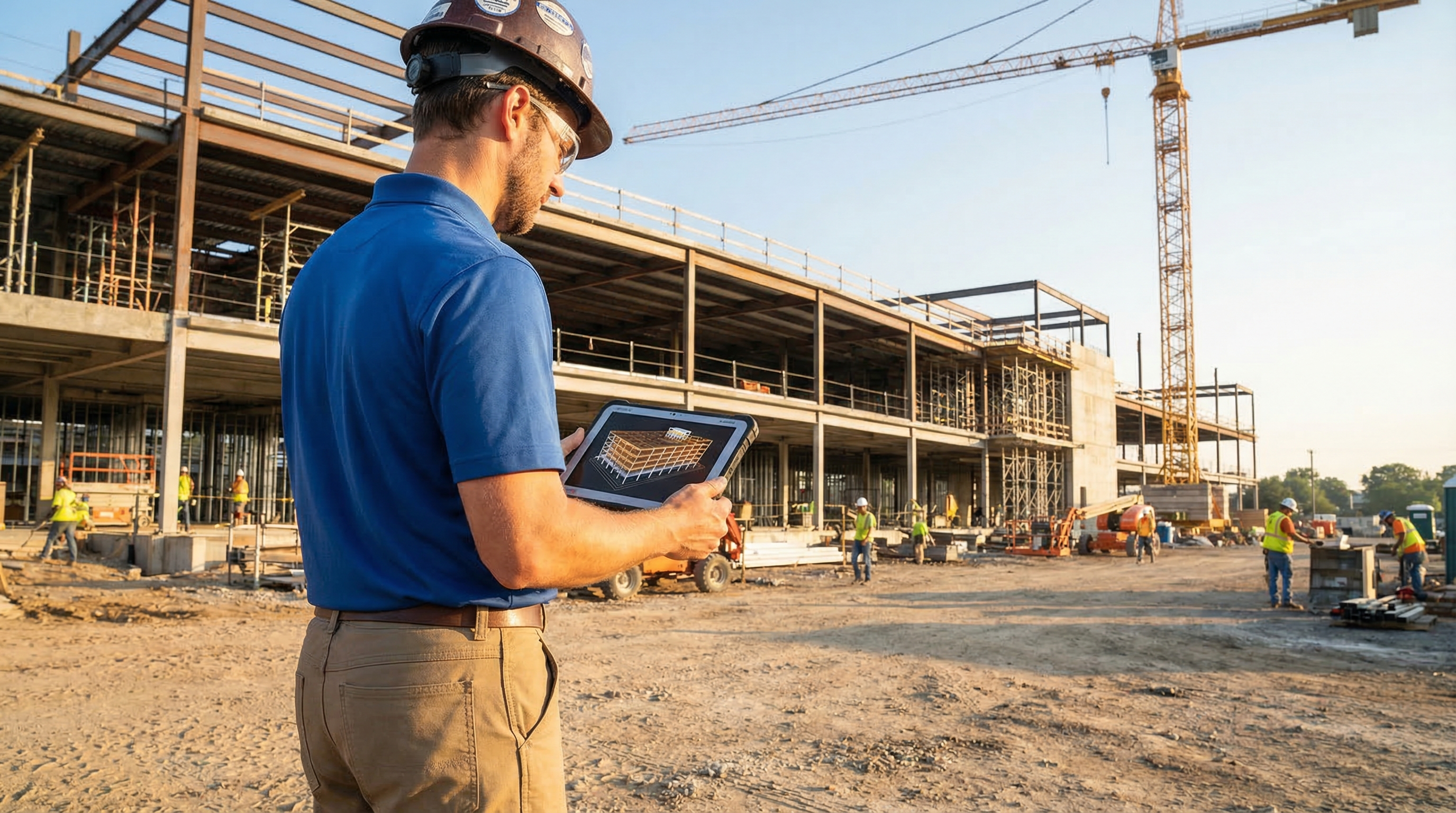
Roughly 30% of all work performed on construction sites is rework — tearing out and redoing something that was already built once. The Construction Industry Institute pegs direct rework costs at 4–10% of total project value, and Trimble estimates the broader ripple effects at $177 billion annually across the global industry. That's money spent building the same thing twice because the plans didn't match reality, or because a duct run collided with a steel beam that nobody caught on paper.
Digital twin technology — the practice of creating a dynamic, data-connected virtual replica of a physical asset — is increasingly the tool construction firms reach for to solve that problem. And in 2026, it's no longer confined to billion-dollar megaprojects. Mid-market general contractors, specialty trade firms, and regional developers are deploying digital twins on projects as modest as 80,000-square-foot office buildings, driven by cloud platforms that have slashed the upfront cost of entry.
The Market Is Moving Fast
Grand View Research valued the global digital twin market at $35.82 billion in 2025, projecting it to reach $328.51 billion by 2033 at a compound annual growth rate of 31.1%. That's not construction-specific — the technology spans manufacturing, energy, healthcare, and infrastructure — but the building sector is one of the fastest-growing verticals within it.
Gartner projects that digital twins will "cross the chasm" in 2026, moving from early-adopter territory into mainstream enterprise deployment, with the broader market reaching $183 billion in revenue by 2031. The research firm also forecasts that over 40% of large companies globally will have adopted digital twins in revenue-focused projects by 2027.
McKinsey estimates digital twins could improve capital and operational efficiency on large-scale infrastructure projects by 20–30%, a figure that compounds when applied across a portfolio of builds.
The building twin sub-market specifically — covering construction lifecycle, operations, and facilities management twins — hit $4.18 billion in 2026, according to Straits Research, with lifecycle twins accounting for over 41% of that revenue.
What Digital Twins Actually Do on a Job Site
A BIM model captures a building as designed. A digital twin captures a building as it actually performs, in real time. That distinction sounds academic until a subcontractor is standing in a mechanical room wondering why the HVAC chase doesn't line up with the structural steel.
In practice, construction digital twins serve three primary functions that address specific, measurable problems:
Pre-construction simulation and clash detection. Before a foundation is poured, teams run the entire build virtually — sequencing crane movements week by week, testing prefabricated component assembly, and identifying conflicts between mechanical, electrical, plumbing, and structural systems. Peer-reviewed research published in PM World Journal documented a 32% reduction in design errors when digital twins connected with BIM platforms, and a 27% improvement in design cooperation through real-time collaboration.
Real-time progress monitoring. IoT sensors and continuous data feeds let project managers visualize construction evolution as it happens, surfacing schedule deviations immediately rather than through weekly site walks. The HS2 high-speed rail project in the UK deployed thousands of IoT sensors integrated into a digital twin to monitor equipment performance and ground conditions across 140 miles of new track.
Design-to-operations handoff. Traditionally, the information captured during construction dies when the project is handed over to the owner. Digital twins extend the data stream through the operational phase, connecting building systems, sensors, and utility meters into a continuous information pipeline that supports facilities management for decades.
Real Projects, Real Numbers
The most cited large-scale example is Turner Construction's work on the Salesforce Tower in San Francisco. By deploying a digital twin for real-time progress monitoring and logistics optimization, the firm reported $15 million in cost savings while maintaining a perfect safety record throughout the build — a notable achievement on a 1,070-foot supertall tower in a dense urban core.
Skanska adopted digital twin technology on the Stockholm New Metro project, one of Scandinavia's largest infrastructure programs. The result was a 20% reduction in construction time, attributed to improved communication across trades and more efficient resource allocation across the sprawling underground network.
A NIST construction case study documented three months saved and $3 million in cost reduction on a single project through digital twin-enabled coordination — demonstrating that the ROI isn't limited to marquee towers and transit systems.
Peer-reviewed research documents 10–20% reductions in project timelines and 5–30% cost savings through better resource allocation and reduced rework when digital twins are deployed in construction.
In Hong Kong, Gammon Construction built a proprietary digital twin platform called GTwin, deploying it across projects ranging from the 1,450-seat Lyric Theatre Complex to the Cyberport business park. The platform integrates geospatial data, BIM models, and real-time sensor feeds into a single operational view — and Gammon has made it a standard tool across its project portfolio, not a one-off experiment.
The Mid-Market Opening
For years, digital twins were effectively off-limits for firms without enterprise-level budgets. Full-scale implementations on a 600,000-square-foot commercial office building run $1.2 million to $1.7 million, and complex hospital builds can exceed $4 million. That's a non-starter for most mid-market contractors.
Three shifts are changing that math in 2026.
Cloud-native platforms have dropped the entry cost. Bentley Systems' iTwin platform, integrated with NVIDIA Omniverse for GPU-accelerated visualization, offers subscription-based access to digital twin capabilities that previously required dedicated on-premises infrastructure. Autodesk, Trimble, and Dassault Systèmes have all released or expanded cloud digital twin tools targeted at firms that can't justify seven-figure IT investments.
BIM serves as a foundation, not a separate investment. Over 70% of large commercial and industrial projects in North America now require BIM deliverables as standard documentation. For firms already running BIM workflows, adding digital twin capabilities is an incremental extension — not a ground-up technology replacement. The additional cost for mid-size commercial projects (80,000–150,000 square feet) typically adds 0.5–2% to design and preconstruction fees.
Mobile-first reality capture lowers the hardware barrier. Smartphone-based 3D scanning, consumer 360-degree cameras, and tablet-based field capture tools now provide sufficient accuracy for many mid-market use cases without the capital expense of enterprise laser scanning equipment.
See how much revenue you're leaving on the table
Take our 2-minute Revenue Leakage Assessment
Start AssessmentThe Safety Dimension
Construction remains one of the most dangerous industries in any developed economy, and digital twins are producing measurable improvements on that front. Peer-reviewed research reports 15–25% decreases in safety incidents when AI-driven risk detection is layered onto digital twin platforms.
The mechanism is straightforward: simulating a build sequence before executing it physically reveals fall hazards, equipment conflicts, and congested work zones that would otherwise surface only when workers are already in harm's way. Turner's safety record on the Salesforce Tower isn't incidental — it's a direct consequence of running logistics and sequencing through a virtual environment first.
For mid-market contractors competing on safety records to win insurance rates and owner confidence, this isn't an abstract benefit. It's a direct line item on the P&L.
Where the Technology Falls Short
Digital twins are not magic. The most commonly cited barrier is data integration — construction sites produce wildly inconsistent data across dozens of trades, subcontractors, and software systems. Standardizing that information into a coherent digital twin requires organizational discipline that many firms haven't built yet.
Skills gaps remain a real constraint. According to Autodesk research, 64% of architecture and engineering executives report measurable value from digital twin investments — but that means more than a third are still struggling to realize returns, often because they lack the in-house expertise to maintain and interpret the models.
Legacy system integration is another sticking point. Firms running older ERP, project management, and accounting systems face real friction connecting those tools to real-time digital twin data streams. The technology works best when it plugs into a modern, connected software stack — and many mid-market firms aren't there yet.
What to Watch in 2026 and Beyond
Three trends will define the next phase of digital twin adoption in construction.
AI-powered predictive analytics. Digital twins are increasingly paired with machine learning models that don't just mirror current conditions but forecast future ones — predicting schedule delays, cost overruns, and equipment failures before they materialize. NMSC research anticipates a 30% uptick in AI-twin adoptions for city infrastructure projects by late 2026, driven by partnerships like the Bentley-NVIDIA collaboration.
Standardization through regulation. More public agencies and institutional owners are writing digital twin deliverables into their RFPs and contract requirements. As this becomes standard practice rather than a differentiator, firms that haven't invested will find themselves locked out of entire project categories.
Lifecycle value over construction-phase value. The biggest return on digital twins may not come during construction at all. Property owners using digital twins for ongoing operations are reporting energy consumption reductions of up to 50% and operating cost cuts of 35%, according to Fortune Business Insights. As owners realize this, they'll increasingly demand digital twin handoffs at project completion — making the technology a condition of winning work, not just a tool for executing it.
The firms moving now aren't doing so because the technology is trendy. They're doing it because the math works: fewer errors, shorter schedules, lower insurance costs, and a deliverable that extends their client relationship from construction into decades of facility operations. For mid-market contractors weighing the investment, the question isn't whether digital twins will become standard practice. It's whether they'll be early enough to build the expertise before their competitors do.
Stay ahead of the curve
Get weekly insights on distribution technology and AI automation.
The full platform, in your team's pocket.
iOS and Android apps for field reps, drivers, and warehouse teams. Online or offline.
See Workd Mobile