
The Quiet Death of the Purchase Order Fax Machine


Somewhere in the back office of a plumbing supply house in central Ohio, a beige fax machine sits on a metal shelf gathering dust. Its paper tray is empty. The phone line running to it was disconnected six months ago. Nobody noticed.
That fax machine processed purchase orders for 22 years. It was the primary way the company's 140 wholesale customers placed orders, curling thermal paper rolling off the machine at all hours, manually keyed into an ERP by a clerk the next morning. The process worked, in the way that a manual transmission works: functional, familiar, and utterly outclassed by what replaced it.
Across the wholesale distribution industry, a quiet technology shift is underway. Lightweight, cloud-based EDI platforms are reaching the small and mid-market distributors who were shut out of electronic data interchange for decades by cost, complexity, and the sheer inertia of "good enough" manual processes. The fax machine isn't dying because anyone declared war on it. It's dying because the alternatives finally became cheap enough to ignore.
The Cost Barrier That Kept Small Distributors Analog
Traditional EDI implementation has historically required $10,000 to $50,000 in upfront investment, plus ongoing per-transaction fees and dedicated IT staff to manage mapping, compliance, and error resolution. For a $200 million retailer trading with hundreds of suppliers, that math works. For a $15 million electrical distributor with 80 vendor relationships, it never did.
The global EDI software market reached $2.23 billion in 2024 and is projected to hit $3.94 billion by 2029, growing at 12.5% annually, with SME adoption driving the fastest-growing segment.
, The Business Research Company, 2025
The result was a two-tier ordering ecosystem that persisted well into the 2020s. Large distributors ran automated EDI pipelines. Everyone else relied on a patchwork of fax machines, emailed PDF purchase orders, phone calls, and the occasional typed-out order in a supplier web portal. According to a 2024 Statista report, approximately 17% of businesses globally still relied on fax machines for critical operations, with B2B ordering among the most persistent use cases in distribution and healthcare.
The fax machine market itself tells the story: valued at roughly $949 million in 2024, it's shrinking at a 5% annual rate, according to Business Research Insights. That decline isn't happening because fax technology broke. It's happening because a new class of platforms has eliminated the reasons small businesses clung to it.
What EDI-Lite Actually Looks Like
The term "EDI-lite" is informal, but it describes a real product category: cloud platforms that handle electronic purchase order exchange without requiring the infrastructure of traditional EDI. Think of it as the difference between running your own email server and using Gmail.
SPS Commerce, the largest player in this space, now operates a network of over 50,000 suppliers, logistics companies, and buying organizations. The Minneapolis-based company reported 22% revenue growth in Q2 2025 and noted that approximately 80% of its customers are still below the 2024 average revenue per user (ARPU) of $13,300, a signal that most of its network consists of smaller businesses running basic order exchange, not enterprise-scale integrations.
Newer entrants are pushing prices even lower. OrderEase, a Canadian platform focused on B2B distributors, offers EDI integration starting at $50 for three trading partner connections. The platform automates order capture from EDI, email, and web portal channels, syncing everything directly to an ERP. Orderful, an API-first EDI platform backed by $46 million in venture funding, has built its pitch around eliminating the mapping complexity that made traditional EDI implementation so expensive.
TrueCommerce takes yet another approach, offering preconfigured ERP adapters for NetSuite, Sage, and Microsoft Dynamics, the systems most common among mid-market distributors. Instead of custom integration projects, distributors activate a connector and start trading within days rather than months.
Why It's Happening Now
Three forces converged to make 2024-2026 the inflection point for small-distributor EDI adoption.
Cloud infrastructure collapsed the cost floor. Running an EDI translation engine used to require on-premise software, a VAN (value-added network) subscription, and staff who understood X12 document standards. Cloud-native platforms amortize all of that across thousands of tenants. The per-customer cost to add a small distributor to a network like SPS Commerce or TrueCommerce is now marginal.
Large trading partners started mandating electronic ordering. Retailers like Walmart, Home Depot, and Amazon Business have progressively tightened their supplier compliance requirements. A $20 million HVAC distributor that once had the luxury of faxing orders to a regional manufacturer now faces chargebacks and delisted SKUs if it can't transmit an 850 purchase order electronically. The mandate trickles down: when big buyers require EDI, their suppliers require it from their suppliers.
Labor costs made manual order entry untenable. The average hourly wage for warehouse and logistics workers in the U.S. reached $25.50 in 2025, according to Speed Commerce. A single order entry clerk processing 100 faxed POs per day represents $53,000 or more in annual labor, not counting the error rate. Manual order entry in warehouses carries a typical accuracy rate of 95-97%, according to Finale Inventory. At 1,000 orders per day, that 3-5% error rate translates to 30-50 daily mistakes, each costing $50 to $300 to resolve through returns, re-ships, and customer credits.
A midsize operation processing 1,000 orders per day with a 1% error rate and an average cost of $50 per mistake loses approximately $130,000 per year, just in rework costs.
, NetSuite, 2026
See how much revenue you're leaving on the table
Take our 2-minute Revenue Leakage Assessment
Start AssessmentThe Real ROI Isn't Speed, It's Visibility
The obvious pitch for EDI-lite platforms is faster order processing. But distributors who've made the switch report that the bigger payoff is something less glamorous: data visibility.
When orders arrive by fax or email, they exist as documents, images of text that must be manually interpreted and entered. There's no structured data until a human creates it. That means no real-time order tracking, no automatic inventory allocation, no demand forecasting based on order patterns, and no way to flag anomalies before they become problems.
Electronic ordering changes the equation. Every PO arrives as structured data that an ERP can immediately consume. Inventory can be allocated at the moment of order receipt rather than the next morning when the clerk gets to it. Backorder notifications can fire automatically. Pricing discrepancies between what the customer ordered and what's in the system can be flagged before fulfillment, not discovered during invoicing.
For distributors running 3-5 disconnected systems, a common configuration in the mid-market, electronic order intake is often the first step toward unifying operations data. It's difficult to build a coherent view of the business when the primary input channel is a stack of thermal paper.
What's Holding the Holdouts
Despite falling costs, a significant number of small distributors remain on manual ordering. The reasons are predictable but worth naming.
Vendor reluctance. Many small distributors sell to customers who are themselves small businesses, independent contractors, local retailers, small manufacturers. Asking a plumber who calls in orders from a job site to adopt EDI is a non-starter. The most practical platforms solve this by supporting multiple input channels simultaneously: EDI for large accounts, a web portal for medium ones, and email or phone order capture with AI-assisted data extraction for the smallest.
ERP limitations. Some distributors run ERP systems from the 1990s and early 2000s that lack modern API connectivity. Integrating an EDI platform with a legacy AS/400-based system can cost more than the EDI platform itself. This is changing as more distributors undertake ERP modernization, a parallel trend that creates a natural on-ramp for electronic ordering.
The "it works" factor. Inertia is the strongest force in small business technology adoption. If the current process handles volume without obvious breakdowns, the motivation to change is low, until a major customer mandates electronic ordering, or a key order-entry employee retires and the company discovers their entire purchasing workflow lived in one person's head.
What Comes After the Fax
The distribution industry is moving toward a model where electronic order exchange is table stakes, not a competitive advantage. The EDI software market's projected growth to $3.94 billion by 2029 reflects not just new adoption but deeper integration, moving beyond basic purchase order exchange to include advance ship notices, invoices, inventory updates, and demand signals flowing automatically between trading partners.
AI is accelerating the transition. Platforms like OrderEase and Cleo are deploying machine learning to extract order data from unstructured emails and PDFs, effectively creating an electronic order from an analog input without requiring the sender to change anything. For the small distributor whose customers will never adopt a portal, this is the bridge technology that makes the fax machine fully redundant.
The broader trajectory is clear. U.S. warehouse costs rose 8.3% from 2022 to 2024, according to Modern Distribution Management. Labor represents 45-55% of total warehouse operating costs. Every manual touchpoint that can be eliminated, and order entry is one of the largest, directly protects margins in an industry where 2-4% net profit is typical.
The fax machine on that shelf in Ohio isn't coming back. The only question for the distributors still running one is how much longer they can afford to wait before its replacement pays for itself. Based on the current economics, the answer for most is: not long.
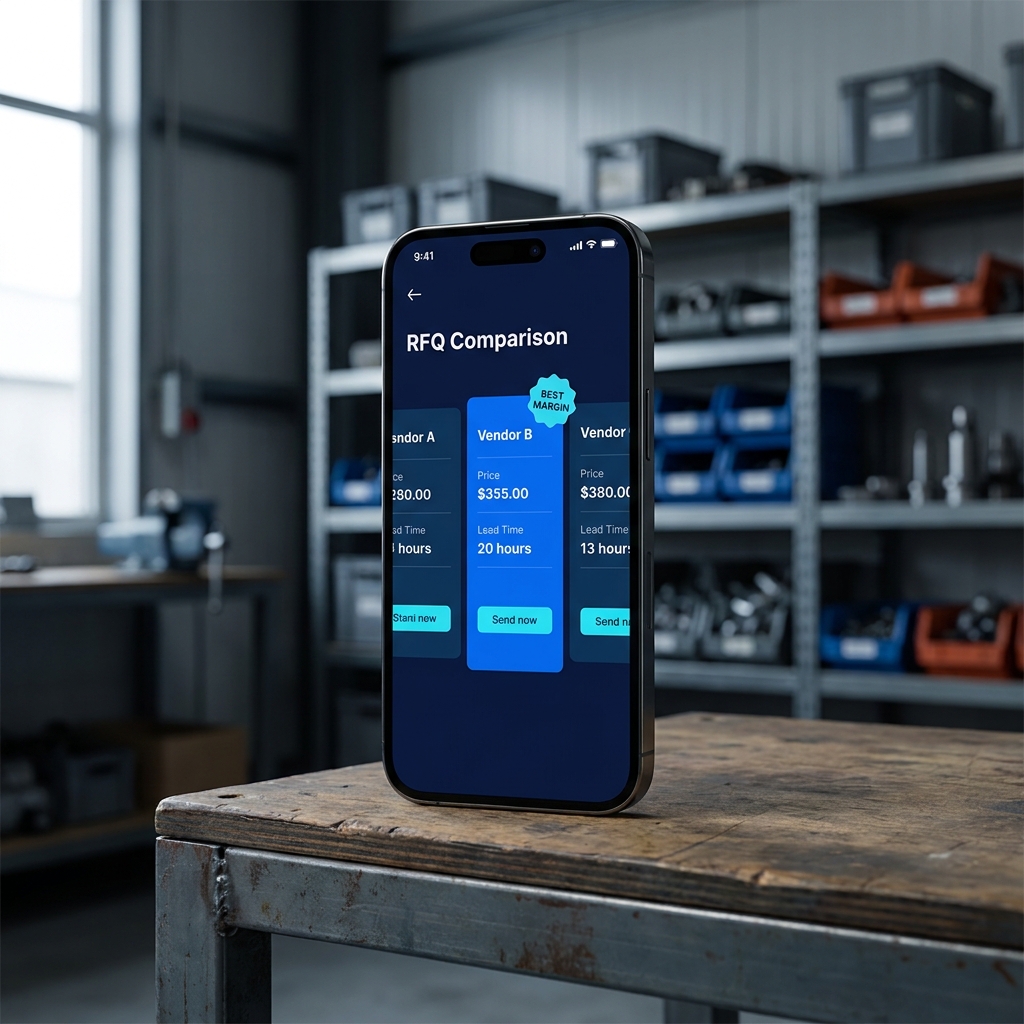
Stop losing margin in the email thread.
Vendor RFQs linked to customer quotes, sales sees real-time vendor pricing on every active quote.
Free Sourcing AuditStay ahead of the curve
Get weekly insights on distribution technology and AI automation.