
AI Is Replacing the Follow-Up Email in B2B Distribution


The average B2B sales rep spends roughly one hour per day on administrative tasks, according to HubSpot's 2024 Sales Trends Report. In distribution, where a single customer might generate dozens of order confirmations, delivery updates, and payment reminders each month, that number is almost certainly higher. Now a growing wave of AI-powered communication tools is eliminating much of that work entirely, and the distributors adopting them are pulling ahead of those still drafting emails by hand.
Gartner predicted that 80% of common customer service issues would be resolved autonomously by AI by 2029. But in B2B distribution, where customer communication is repetitive, structured, and high-volume, that timeline is compressing fast. Companies like Knorr-Bremse, the global brake systems manufacturer, have already deployed AI agents for processing supplier order confirmations with over 95% accuracy, according to a case study from automation platform Nordoon. And they're not alone.
The Communication Bottleneck Nobody Talks About
Distribution is a communication-heavy business. A mid-market distributor with 200 active accounts might send thousands of transactional messages each week: order acknowledgments, shipping notifications, backorder alerts, invoice reminders, credit hold notices, delivery ETAs. Each one is routine. Each one is necessary. And each one has traditionally required a human being to compose, review, and send.
The math is punishing. A 2025 survey from Salesgenie found that 43% of sales professionals reported administrative work occupying between 10 and 20 hours per week, nearly half the standard workweek consumed by tasks that don't directly generate revenue. For inside sales teams at distribution companies, who often serve double duty as customer service reps, the burden is even heavier.
43% of sales professionals spend 10-20 hours per week on administrative tasks
, Salesgenie, 2025 Sales Productivity Report
"The urgency is there, but execution will be key," noted a KeyBanc analyst report on MSC Industrial's digital transformation efforts. That urgency applies across the distribution sector. Companies are sitting on structured data, order histories, shipping records, payment terms, customer preferences, that AI systems can use to generate accurate, personalized communications without human intervention.
What AI-Automated Communication Actually Looks Like
This isn't about chatbots answering questions on a website. The real shift is AI agents that operate inside existing business systems, ERP platforms, order management tools, accounting software, and proactively communicate with customers based on real-time events.
When a purchase order arrives, the AI agent can instantly confirm receipt, validate line items against inventory, flag any discrepancies, and send a detailed acknowledgment to the customer. When a shipment leaves the warehouse, the agent generates a tracking notification. When an invoice hits 30 days past due, the agent sends a structured payment reminder with account details and payment links. No human touches the keyboard.
Stella Home Deliveries, a last-mile delivery company, deployed Package.ai's AI-powered customer engagement platform and saw delivery confirmation rates jump 60%, according to a case study published in 2025. The system used automated chatbot conversations to confirm delivery windows, reschedule when needed, and reduce failed first-delivery attempts. For a distribution company handling hundreds of deliveries daily, those numbers translate directly to fewer returned shipments, lower freight costs, and happier customers.
The Distribution Giants Are Already Moving
The largest distributors in North America aren't waiting. According to Digital Commerce 360's reporting on Q1 2025 earnings calls, companies like W.W. Grainger, MSC Industrial Direct, Fastenal, and Watsco are investing heavily in digital infrastructure that underpins AI-driven communication.
Fastenal reported that digital channels accounted for 61% of its Q1 2025 sales, with its Fulfillment Management Inventory and eBusiness programs generating over $1.2 billion in quarterly revenue. These systems embed Fastenal's ordering and communication tools directly into customer operations. Jefferies described the approach as "a model for integrating physical distribution with digital control." When your system is already inside the customer's facility, automating the communication layer becomes a natural next step.
Grainger, meanwhile, has been using AI to power search relevance, product recommendations, and inventory management across its Zoro.com and MonotaRO.com platforms. Raymond James noted that Watsco's "mobile-first position gives it a head start if and when it leans into AI" for features like chat-enabled order assistance and predictive stock alerts.
For mid-market distributors, companies doing $10 million to $500 million in revenue, this creates a competitive squeeze. Enterprise players are automating their customer communication at scale. Smaller competitors are adopting lightweight AI tools that punch above their weight. The companies in the middle, still relying on manual email workflows and phone-tag follow-ups, risk falling behind on both sides.
The ROI Case: Beyond Time Savings
The obvious benefit is labor efficiency. If an AI agent handles 80% of routine customer communication, that's real headcount capacity freed up for relationship building, problem-solving, and selling. HubSpot found that AI tools were already saving sales professionals roughly two hours per day in 2024.
But the deeper ROI comes from consistency and speed. A human rep might forget to send a backorder notification, delay an invoice reminder, or use inconsistent language across accounts. An AI agent sends every message on schedule, with the right account details, in the right format, every time. For distributors where a single missed delivery update can erode trust with a key account, that reliability has real dollar value.
AI tools saved sales professionals ~2 hours per day in 2024
, HubSpot Sales Trends Report, 2024
There's also a receivables angle. Automated payment reminders sent at consistent intervals, 15 days, 30 days, 45 days, with escalating urgency and clear payment links can meaningfully accelerate collections. Distributors running on thin margins can't afford to let AR stretch to 60 or 90 days because a rep got busy and forgot to follow up.
The Risks Are Real
None of this means distributors should hand over customer communication to AI without guardrails. The risks are real and specific to the B2B context.
A miscommunicated price, an incorrect delivery ETA, or an overly aggressive collections message sent to a top account can do serious damage. In B2B distribution, relationships are long-term and high-value. A $2 million annual account that feels like it's being "handled by a robot" may start taking calls from competitors.
The practical approach most companies are taking: automate the routine, flag the exceptions. AI handles order confirmations, shipping updates, and standard reminders. Anything involving a dispute, a pricing negotiation, a credit decision, or a high-value account escalation gets routed to a human. McKinsey's 2025 State of AI report found that no more than roughly 10% of organizations had scaled AI agents in any single business function, suggesting most companies are still in pilot or limited deployment, and that caution is warranted.
Is your team ready for AI?
Take the 2-minute AI Readiness Assessment
Check Your ReadinessWhat Mid-Market Distributors Should Do Now
Distributors don't need enterprise budgets to start automating communication. The market for AI-powered transactional messaging tools has matured significantly over the past 18 months, with platforms specifically designed for B2B workflows that integrate with common ERP systems.
The starting point is auditing the communication load. How many order confirmations, shipping notifications, and payment reminders does the team send each week? Which ones are truly templated and repetitive? Which ones require judgment and context? Most distributors find that 60-80% of outbound customer communication follows predictable patterns, and that's the automation target.
From there, the implementation path is straightforward: connect AI tools to order management and accounting systems, define communication rules and templates, set escalation triggers for exceptions, and monitor customer response patterns. The companies seeing the best results are starting with a single communication type, order confirmations are the most common entry point, proving the model, and expanding from there.
The distributors that figure this out first won't just save their reps a few hours a day. They'll respond faster, collect sooner, and communicate more reliably than competitors still typing emails at 4 PM on a Friday. In a market where Gartner projects 90% of B2B purchases will flow through AI agents by 2028, the follow-up email may be the first thing to go.
Stay ahead of the curve
Get weekly insights on distribution technology and AI automation.
Go Deeper in the Resource Library
Get AI prompts, implementation templates, SOPs, and call scripts built for distribution companies. 47+ resources and growing, free access.
Access the Resource Library, FreeAlso free: Workdshop live sessions for distribution leaders
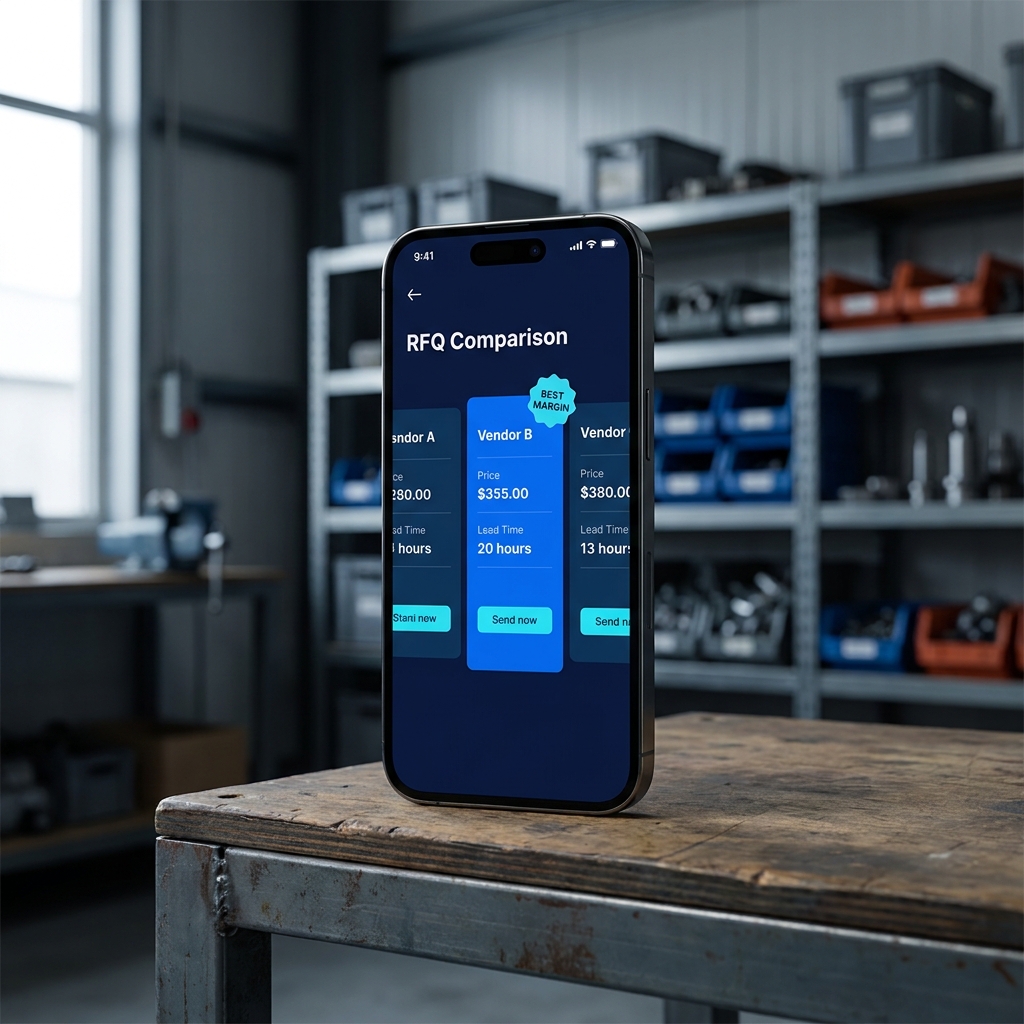
Stop losing margin in the email thread.
Vendor RFQs linked to customer quotes, sales sees real-time vendor pricing on every active quote.
Free Sourcing Audit