
AI Panic Hits Logistics Stocks: What the Freight Efficiency Selloff Means for Distribution

On February 12, 2026, a former karaoke machine company wiped billions of dollars off the trucking industry's market cap.
Algorhythm Holdings, previously known for its Singing Machine karaoke business, which it sold for $4.5 million in 2025, announced that its SemiCab AI freight platform was helping live customers scale freight volumes by 300% to 400% without increasing headcount. The platform, the company claimed, reduced empty freight miles by more than 70% across active customer networks.
Wall Street's response was immediate and violent. C.H. Robinson, one of the world's largest freight brokerages, fell 14.5% in a single session. RXO dropped 20.5%. Expeditors International lost 13.2%. J.B. Hunt declined 5%. XPO fell nearly 6%. The Russell 3000 Trucking Index dropped 6.6%, according to The Guardian's coverage of the selloff. Algorhythm's own stock, a penny stock the day before, surged 29.9%.
For distributors watching from the sideline, companies that ship product but don't operate fleets, the knee-jerk reaction might be to shrug. This looks like a Wall Street story, not an operations story. That reading would be wrong.
Why Distributors Should Care About Freight Broker Panic
Mid-market distributors don't typically own their trucking capacity. They rely on freight brokers, third-party logistics providers, and carrier networks to move product from warehouses to customers. When the companies managing those networks face existential pressure, from AI, from margin compression, from disintermediation, it filters down to every shipper in the ecosystem.
The fear driving the selloff isn't that trucks will disappear. It's that the middlemen who coordinate freight, the brokers, the 3PLs, the logistics coordinators, could be disintermediated by AI platforms that connect shippers directly to carriers with enough precision to eliminate the coordination layer entirely. Financial Content's analysis described the dynamic as "disintermediation": AI connecting shippers to carriers so efficiently that the traditional broker becomes obsolete.
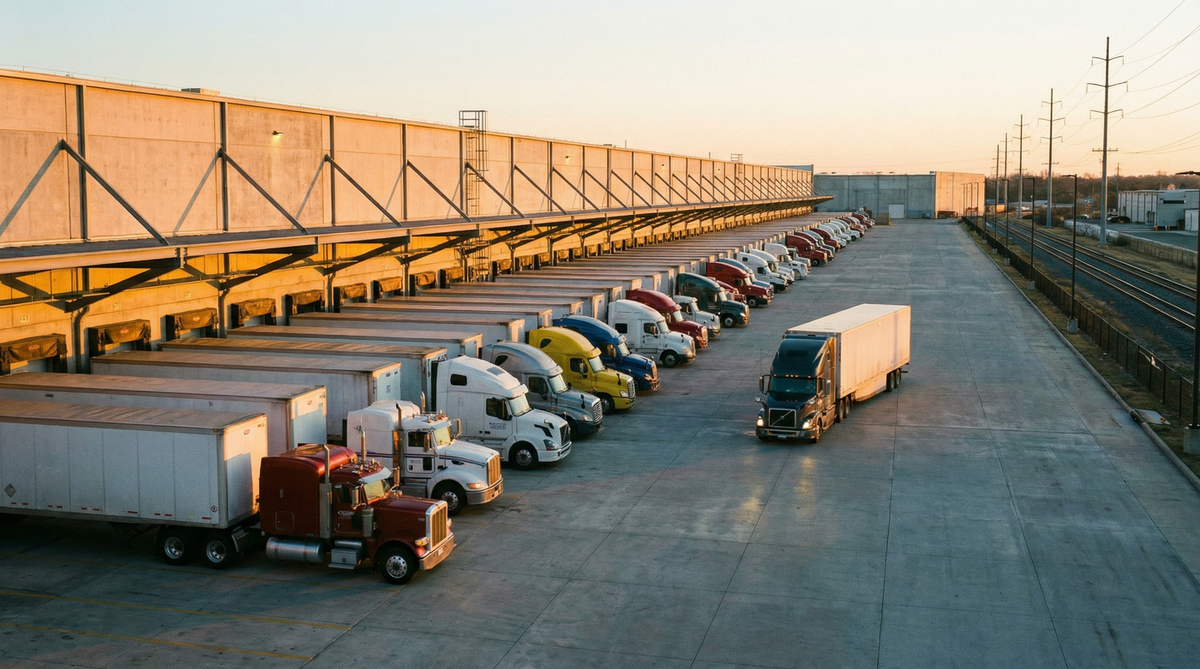
American trucks drive empty nearly one out of every three miles, representing more than $1 trillion in wasted freight spending annually.
Source: Mordor Intelligence, cited by SemiCab
That trillion-dollar inefficiency is the opportunity that AI platforms are targeting. If even a fraction of those empty miles get eliminated through better matching algorithms, the ripple effects reshape freight pricing, carrier availability, and the economics of every company that ships goods for a living.
The "Prove It" Year
Not everyone is buying the panic. Baird analyst Daniel Moore reiterated his outperform ratings on C.H. Robinson and Expeditors in the wake of the selloff, noting in a research note that "automation is not a new theme," according to CNBC's reporting. The implication: incumbents have been investing in their own AI and automation capabilities for years. A single platform announcement from a micro-cap company doesn't erase that work overnight.
Jack Herr, a primary investment analyst at GuideStone Funds, described 2026 as a "prove it" year for AI in logistics, telling Tredu that the market is testing whether productivity gains show up in margins and cash flow, not just product demos. It's a measured take in a market that has been anything but measured.
The tension is real, though. SupplyChainBrain reported in January 2026 that 96% of transportation leaders said they currently use AI across planning and operations, most commonly for analytics and reporting (77%), route and load optimization (63%), and freight demand and capacity forecasting (56%). The technology isn't hypothetical. The question is how far it goes and how fast.
What the Numbers Say About AI in Logistics
McKinsey's research on AI in distribution operations found that embedding AI can reduce logistics costs by 5% to 20%, inventory levels by 20% to 30%, and procurement spend by 5% to 15%. Those aren't revolutionary numbers in isolation. But applied across a $50 million distribution operation spending $3 million annually on freight, even a 10% logistics cost reduction represents $300,000 in annual savings, real money for a mid-market company.
The more granular data from McKinsey's supply chain analysis showed companies actively using AI in supply chains have already achieved a 12.7% drop in logistics costs and a 20.3% reduction in inventory levels. Those results came from early adopters with the resources to implement properly.
But implementation isn't cheap or easy. Gartner found that 62% of supply chain AI initiatives exceed their budgets by an average of 45%, primarily due to unforeseen data preparation requirements and integration complexities. That gap between the promise and the reality of AI deployment is exactly what makes the current moment so volatile, for investors and operators alike.
Three Scenarios for Distributors
The SemiCab-driven selloff crystallizes three possible futures for how AI reshapes the freight layer that distributors depend on.
Scenario one: Incumbents absorb the technology. C.H. Robinson, XPO, and other major brokers integrate AI optimization into their existing networks. Freight costs decline modestly, service improves incrementally, and the broker model survives in a more efficient form. This is the most likely near-term outcome and what analysts like Moore appear to be betting on. For distributors, this means gradually falling freight costs and better visibility, a positive development that requires no dramatic action.
Scenario two: New platforms disintermediate brokers. AI-native freight platforms gain enough traction to connect shippers directly to carriers at scale, cutting out traditional brokers. Freight costs drop significantly, but so does the service layer that many distributors rely on for exception handling, claims management, and relationship-based problem solving. Distributors in this scenario need to invest in their own logistics operations capability or find new partners who combine AI efficiency with operational depth.
Scenario three: Consolidation accelerates. The threat of AI disruption drives a wave of mergers among freight brokers and 3PLs, creating fewer, larger logistics providers with the capital to invest in AI at scale. Mid-market distributors lose negotiating leverage as their carrier and broker options shrink. This scenario, already underway in parts of the industry, would pressure distributors to lock in long-term logistics partnerships before the consolidation wave reduces their options.
96% of transportation leaders say they currently use AI across planning and operations, with 63% applying it to route and load optimization.
Source: SupplyChainBrain, January 2026
What Mid-Market Distributors Should Do Now
The freight AI shakeout doesn't require panic. It requires attention. Four concrete steps apply regardless of which scenario plays out.
Audit your freight spend and relationships. Know exactly what you're paying per lane, per carrier, per shipment type. If your 3PL can't provide transparent, granular data on your freight costs, that opacity is itself a problem, and one that AI platforms are specifically designed to exploit.
Ask your logistics partners about AI. Not in vague terms. Ask specifically: What AI tools are you using for route optimization? Load matching? Capacity forecasting? Are you building or buying? The answers will tell you whether your partner is positioning to survive the shift or will be disrupted by it.
Evaluate your own operations data. AI-driven freight platforms work best when they have clean, structured data about shipping patterns, volume seasonality, and lane preferences. Distributors whose operations data lives in email chains and spreadsheets won't be able to take advantage of freight AI tools, whether those tools come from their existing broker or a new platform, without first addressing the data foundation.
Watch the consolidation. If your primary freight broker or 3PL gets acquired in the next 12 months, your service terms, contact relationships, and pricing will likely change. Having a backup relationship isn't just risk management, it's leverage in a market where the balance of power between shippers and logistics providers is actively shifting.
See how much revenue you're leaving on the table
Take our 2-minute Revenue Leakage Assessment
Start AssessmentThe Bigger Signal
The February 12 selloff in logistics stocks is part of a broader pattern that's been building throughout early 2026, what some market observers have labeled "Software-mageddon." AI isn't just disrupting tech companies and creative industries. It's reaching into the physical economy: trucking, warehousing, freight coordination, the industrial infrastructure that moves goods from factory to customer.
For distribution companies, the message isn't that AI is coming for your business. It's that AI is restructuring the businesses you depend on. The carriers you ship with, the brokers you route through, the 3PLs you rely on for last-mile delivery, all of them are facing the same question: adapt to AI-driven efficiency or lose ground to someone who will.
That restructuring will eventually reach distributors directly. The companies that understand their own logistics data, maintain strong operational foundations, and choose partners who are investing in AI capability, rather than running from it, will navigate the transition from a position of strength. The ones who assume the freight layer is someone else's problem will find out the hard way that disruption doesn't stop at the loading dock.
Stay ahead of the curve
Get weekly insights on distribution technology and AI automation.
Go Deeper in the Resource Library
Get AI prompts, implementation templates, SOPs, and call scripts built for distribution companies. 47+ resources and growing, free access.
Access the Resource Library, FreeAlso free: Workdshop live sessions for distribution leaders

Run every brand on its own storefront, one backend.
HF Foods runs 16+ sub-brands on Workd. See the architecture in a 15-minute walkthrough.
See How HF Foods Did It