
The AI Implementation Playbook: A 6-Week Plan for B2B Operations Teams


An MIT Media Lab report published in 2025 found that 95% of enterprise generative AI initiatives failed to deliver measurable impact on the P&L. The research, based on 150 executive interviews and analysis of 300 public AI deployments, identified a stark divide: the companies that succeeded picked narrow operational problems and executed fast, while the majority stalled in endless pilots with vague objectives.
For mid-market B2B distributors, that finding should be both a warning and an opportunity. The six-week framework below is designed to keep operations teams on the right side of that divide — moving from evaluation to production results before organizational inertia kicks in.
Why Six Weeks — and Why Operations First
According to IDC research cited by CIO, 88% of AI pilots never reach production. The primary culprit is not technology — it's scope creep, unclear ownership, and the gap between proof-of-concept and actual workflow integration.
Six weeks works because it's short enough to maintain executive attention and long enough to prove real value. And back-office operations is the right starting point for a specific reason: the MIT report found that the biggest returns from AI came not from sales and marketing tools — where more than half of generative AI budgets were being directed — but from back-office automation that eliminated manual processes and reduced outsourcing costs.
According to Gartner, early adopters of generative AI saw 15.2% cost savings and a 22.6% productivity improvement on average.
For distributors processing hundreds of orders daily, managing complex credit terms, and coordinating field sales teams, those percentages translate directly to headcount efficiency and faster cash cycles.
Week 1–2: Audit and Quick Wins
The first two weeks are about finding the low-hanging fruit — repetitive, rule-based tasks that consume disproportionate staff time. In most distribution operations, three areas consistently surface:
Order entry and processing. Distributors that still re-key orders from emails, faxes, and phone calls into their ERP are burning hours that AI can reclaim immediately. Document extraction tools can parse purchase orders, match them to catalog SKUs, and stage orders for human review — reducing touch time per order from minutes to seconds.
Accounts receivable follow-up. A 2025 study by Vanson Bourne, surveying 500 finance professionals, found that AR automation accelerated payments by 40%, with 92% of respondents reporting faster cash flow after implementation. For distributors carrying 45- to 60-day receivables, that acceleration directly improves working capital.
Inventory exception handling. Rather than attempting full demand forecasting in week one, start with anomaly detection: flagging stockouts, unusual order patterns, or mismatched counts. This delivers immediate visibility without requiring months of model training.
The goal for these two weeks is straightforward: identify the three highest-impact, lowest-risk processes. Map the current workflow. Measure the baseline — how long each task takes, how many errors occur, how many people are involved. Then select one to automate first.
Week 3–4: Customer-Facing Automation and Voice AI
With one internal process moving toward automation, week three shifts to customer-facing operations. This is where voice AI enters the picture.
Market.us reports that 80% of businesses plan to integrate AI-driven voice technology into customer service functions by 2026. Distribution is a natural fit: customers calling to check order status, request pricing, or place reorders follow predictable patterns that voice AI handles well.
The implementation approach matters. Companies that succeed with voice AI in B2B environments typically follow a specific sequence:
Start with inbound status inquiries. "Where's my order?" calls are high-volume, low-complexity, and customers don't mind automated responses when the information is accurate and instant. Connect the voice system to your ERP's order tracking data, and the majority of these calls resolve without a human.
Add after-hours coverage. Most distributors lose calls between 5 PM and 8 AM. A voice AI system that can take reorders, answer stock questions, and route urgent issues to on-call staff captures revenue that otherwise walks to a competitor with better availability.
Defer complex negotiations. Pricing discussions, credit disputes, and new account setup still require human judgment. The goal in weeks three and four is not to replace sales reps — it's to free them from routine calls so they can focus on relationship-building and complex deals.
BCG research found that companies deploying AI in customer experience achieved productivity improvements between 15% and 30%. In distribution, that improvement often shows up as faster response times, fewer missed calls, and sales reps spending more hours in front of customers rather than behind a phone.
Week 5–6: Workflow Integration and Measurement
The final two weeks are about connecting the dots and proving ROI. This is where most pilots die — not from technical failure, but from lack of measurement.
By week five, the team should have at least one back-office automation live and one customer-facing system in pilot. The task now is integration: making sure these systems feed data back into the ERP, CRM, or operational dashboards the team already uses.
Connect the data loops. An AI system that processes orders but doesn't update inventory counts creates more problems than it solves. Similarly, a voice AI system that takes reorders but doesn't sync with the sales rep's account history undermines the customer relationship. Integration is not optional — it's the difference between a demo and a tool.
Measure what matters. Track three categories of metrics:
- Efficiency: Time saved per task, reduction in manual touches, error rates before and after
- Financial: Cost per transaction, days sales outstanding (DSO) improvement, revenue captured from after-hours orders
- Capacity: How many additional orders, calls, or accounts the team can handle without adding headcount
Research from Sequencr, citing multiple enterprise studies, found that every $1 invested in generative AI returned an average of $3.70 — but only when implementations targeted specific operational workflows rather than broad, undefined use cases.
Build the case for expansion. The six-week plan is not meant to be the end — it's meant to produce enough evidence to justify the next round of investment. Document the wins, quantify the savings, and present them in terms the CFO cares about: reduced cost per order, lower DSO, improved fill rates, and revenue per sales rep.
The Patterns That Separate Success from Stalled Pilots
Across the research, several patterns emerge that distinguish the companies that move AI from pilot to production:
They start narrow. The MIT report noted that successful AI startups "pick one pain point, execute well, and partner smartly." The same applies to operations teams inside established distributors. Trying to automate order entry, AR, inventory, and customer service simultaneously in the first month is a recipe for the 95% failure pile.
They assign clear ownership. Every AI initiative needs a single person accountable for its success — not a committee. In distribution, that's typically an operations manager or VP of operations who understands both the technology and the daily workflow.
They measure from day one. Gartner found that 54% of infrastructure and operations leaders adopted AI primarily to cut costs. But cost reduction only shows up in the numbers if someone is tracking the numbers. Baseline measurement before implementation is non-negotiable.
They accept imperfection early. An AI system that handles 70% of order entries correctly on day one — with human review on the rest — is more valuable than a system that promises 99% accuracy in six months. Ship, measure, improve.
Not sure where AI fits in your operations?
Our Revenue Leakage Assessment identifies the biggest opportunities hiding in your current workflows.
Take the AssessmentWhat Happens After Week Six
McKinsey's 2025 State of AI Global Survey reported that 88% of enterprises now use AI regularly — but Gartner's research showed that only 45% of organizations with high AI maturity kept projects operational for at least three years. The gap between adoption and sustained impact remains wide.
For operations teams that complete the six-week plan, the next phase is scaling what works. That means documenting the playbook — not just the technology choices, but the change management steps, the training materials, the integration points — so the same approach can be applied to the next process, and the next.
The companies that end up in the successful 5% don't treat AI as a project with a start and end date. They treat it as an operational capability that compounds over time, like lean manufacturing or continuous improvement programs before it. The six-week plan gets the flywheel spinning. What happens next depends on whether the organization commits to keeping it turning.
Stay ahead of the curve
Get weekly insights on distribution technology and AI automation.
Go Deeper in the Resource Library
Get AI prompts, implementation templates, SOPs, and call scripts built for distribution companies. 47+ resources and growing — free access.
Access the Resource Library — FreeAlso free: Live virtual training sessions — Thursdays 1 PM ET
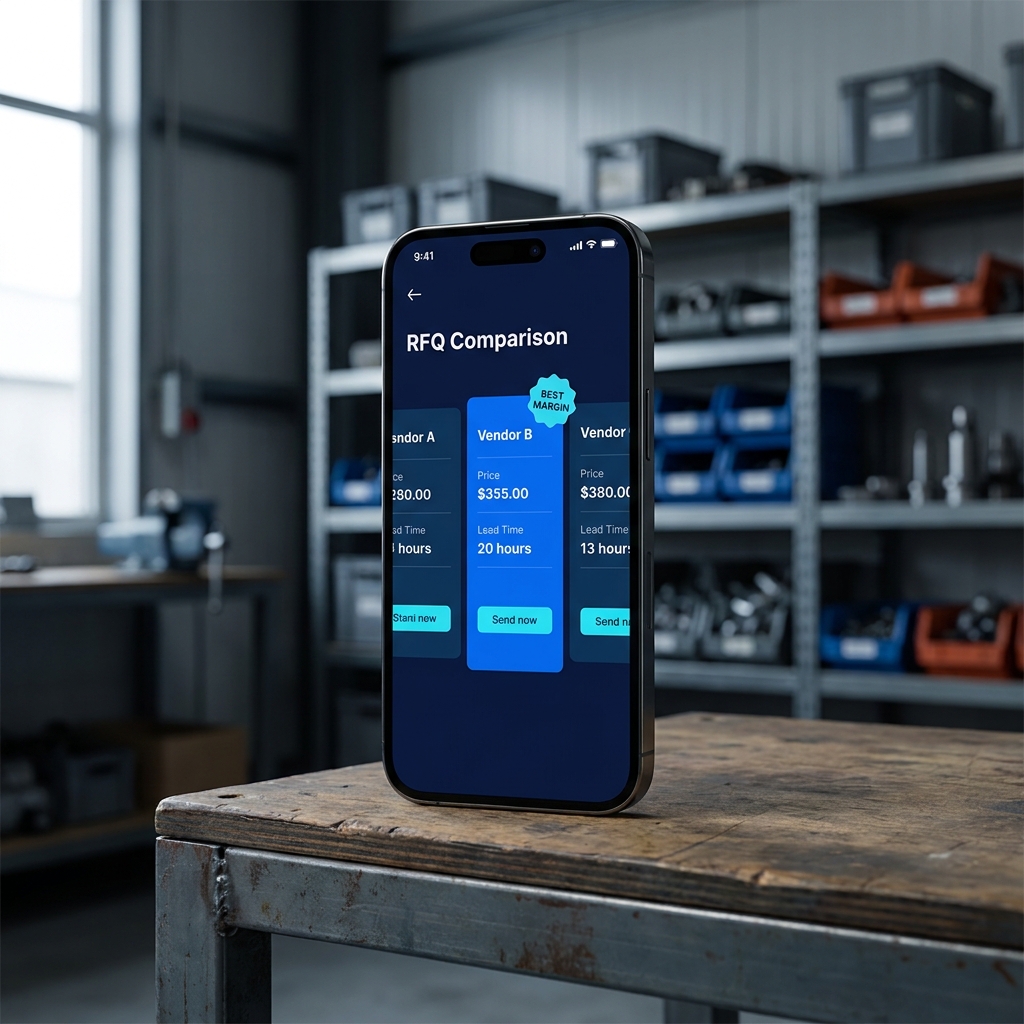
Stop losing margin in the email thread.
Vendor RFQs linked to customer quotes — sales sees real-time vendor pricing on every active quote.
Free Sourcing Audit