
The 2026 Warehouse Labor Crunch: Why Automation Is No Longer Optional for Mid-Market Distributors

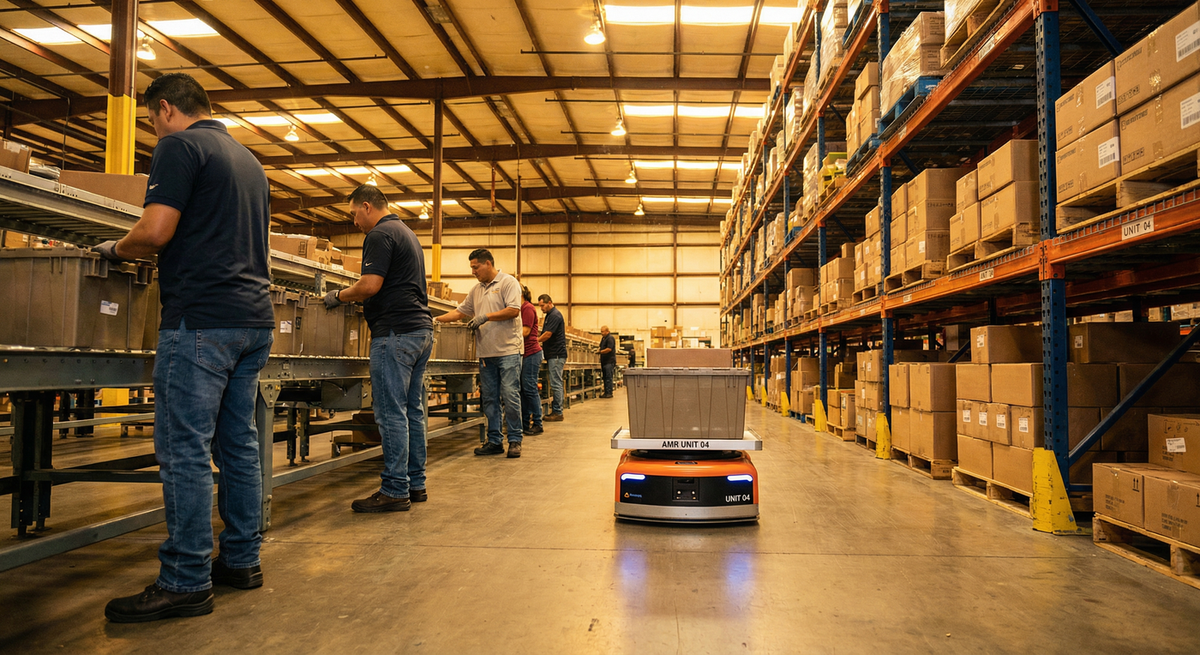
The U.S. warehousing sector employs nearly 1.9 million workers. It can't find enough of them. Annual turnover rates exceed 40%, according to Speed Commerce's 2025 industry data, and 59% of warehouses report struggling to find and retain qualified staff. Average hourly earnings in transportation and warehousing hit $31.52 as of July 2025, per the Bureau of Labor Statistics — competitive with many skilled trades but still insufficient to stop the revolving door.
For mid-market distributors — companies running $10 million to $500 million in revenue with 50 to 500 warehouse employees — the math has become existential. Every unfilled position slows fulfillment. Every new hire costs $5,000 to $10,000 in recruiting and onboarding. Every departure takes institutional knowledge with it. And the labor pool isn't getting bigger.
The warehouse automation market tells the other side of the story. LogisticsIQ projects it will reach $55 billion globally by 2030. Mordor Intelligence pegs the 2025 market at $29.9 billion, growing at 16.2% annually. Interact Analysis revised its 2025 order intake forecast upward to 7% growth, citing stronger-than-expected demand. The money is moving because the labor isn't.
The Numbers Behind the Crunch
The labor shortage in warehousing isn't a single problem — it's three problems compounding simultaneously.
The wage spiral. Warehouse wages have climbed steadily since 2020, driven by pandemic-era competition from e-commerce fulfillment centers and a tightening labor market. At $31.52 per hour average, a full-time warehouse worker costs roughly $65,600 annually in wages alone — before benefits, overtime, workers' comp, and management overhead. For a distributor running a 100-person warehouse, fully loaded labor costs can exceed $8 million per year. When 40% of those workers turn over annually, the company is effectively rehiring and retraining 40 people every year.
The skills gap. Modern distribution warehouses aren't just pick-and-pack operations. They require workers who can operate warehouse management systems, use RF scanners, manage inventory in ERP platforms, and increasingly work alongside automated equipment. Instawork's 2025 State of Warehouse Labor report noted growing demand for flexible workers in skilled positions — transportation logistics, e-commerce fulfillment, inventory management — that go well beyond entry-level material handling.
59% of warehouses report struggling to find and retain qualified workers, with annual turnover rates exceeding 40%.
— Speed Commerce, 2025
The demographic wall. The Bureau of Labor Statistics reported 110,000 additional job openings in trade, transportation, and warehousing in December 2025. Those openings exist against a backdrop of historically low unemployment and declining interest among younger workers in physically demanding warehouse roles. The pipeline of available workers is shrinking even as demand grows.
What Automation Actually Costs — And What It Doesn't
The word "automation" conjures images of fully robotic fulfillment centers — Amazon-scale operations with hundreds of Kiva robots and million-dollar conveyor systems. That's real, but it's not the only version. Mid-market distributors have practical, affordable options that don't require gutting the warehouse.
Voice-directed picking. Voice picking systems replace paper pick lists and handheld scanners with audio instructions delivered through a headset. Workers hear the next pick location, confirm the item verbally, and move on — hands-free. Implementation costs range from $2,000 to $4,000 per user for hardware and software. The ROI case is straightforward: voice picking typically improves accuracy to 99.9%+ and increases pick rates by 10–25%. For a distributor processing 5,000 orders per day, that accuracy improvement alone eliminates thousands of dollars in monthly mis-ship costs.
Autonomous mobile robots (AMRs). Companies like Locus Robotics offer collaborative robots that work alongside existing warehouse staff. The robots navigate autonomously to pick locations, workers place items in the robot's bin, and the robot delivers completed orders to packing stations. AMRs deploy in as little as four months, require minimal infrastructure changes, and — critically for mid-market budgets — many providers offer robotics-as-a-service (RaaS) pricing that converts capital expenditure into a monthly operating cost. Infios reports that AMR deployments typically achieve ROI within six months.
Conveyor and sortation systems. For distributors with consistent, high-volume throughput, conveyor systems eliminate the walking that consumes up to 60% of a picker's time. Modern modular conveyor systems from companies like Quintec are designed for incremental deployment — a distributor can automate one zone at a time rather than committing to a full warehouse retrofit. Capital costs vary widely ($100,000 to $1 million+), but the labor offset is immediate and measurable.
The Software Layer Matters More Than the Hardware
The most consequential automation trend in 2026 isn't any single piece of equipment — it's the orchestration layer that connects everything. Logistics Viewpoints noted in its January 2026 analysis that the differentiator in warehouse automation has shifted from the robots themselves to the software platforms that coordinate AMRs, AGVs, conveyors, and human workers in real time.
For mid-market distributors, this means the warehouse management system (WMS) is the foundation that everything else depends on. A distributor can buy the best voice picking hardware or the most capable AMR, but if the WMS can't dynamically assign tasks, optimize pick paths, and feed real-time data to automated equipment, the investment underperforms.
MCF Corporate Finance's 2025 market outlook observed that warehouse automation order intake and revenue are expected to see high single-digit growth through 2026, followed by strong double-digit growth from 2027 through 2030. The acceleration is driven partly by software maturation — the orchestration platforms are catching up to the hardware, making integrated deployments practical for smaller operations.
The global warehouse automation market is projected to reach $55 billion by 2030, growing at 15% CAGR — driven by labor scarcity, e-commerce volume, and subscription-based robotics services that lower capital barriers.
— LogisticsIQ, 2025
What Mid-Market Distributors Should Prioritize
Not every distributor needs AMRs. Not every warehouse justifies a conveyor system. The right automation strategy depends on volume, product mix, and where labor constraints bite hardest. But some principles apply broadly.
Automate the walking first. In most distribution warehouses, pickers spend 50–60% of their time walking between locations. Any technology that reduces travel time — whether it's voice-directed picking, zone-based picking strategies, or AMRs that bring products to workers — delivers immediate throughput gains without adding headcount.
Start with data, not hardware. Before buying equipment, instrument the current operation. How many picks per hour does each worker complete? What's the error rate by zone? Where are the bottlenecks at peak volume? Without baseline metrics, it's impossible to calculate ROI on any automation investment. A modern WMS with labor tracking should come before the first robot.
Use RaaS to reduce risk. Robotics-as-a-service models eliminate the capital expenditure barrier that historically kept mid-market companies out of automation. Monthly per-robot fees, typically $1,500 to $3,000, convert a $500,000 capital decision into an operating expense that can scale up or down with demand. For distributors with seasonal volume swings, RaaS is particularly compelling.
Treat automation as a labor strategy, not a replacement strategy. The most successful mid-market automation deployments don't eliminate warehouse positions — they make existing workers more productive. A distributor that increases picks per worker from 80 to 120 per hour doesn't fire a third of the team. It handles growing volume without the impossible task of hiring 30 new workers in a market where 59% of warehouses can't fill their current openings.
Is your tech stack ready for AI?
Take our free AI Readiness Assessment
Check Your ReadinessThe Window Is Closing
The distributors that will struggle most in the next three years aren't the ones that chose the wrong automation technology. They're the ones that chose to wait. Labor costs aren't reversing. Turnover isn't improving. Customer expectations for faster, more accurate fulfillment aren't softening.
The warehouse automation market's projected trajectory — from $29.9 billion in 2025 to over $55 billion by 2030 — isn't driven by large enterprises alone. It's increasingly driven by mid-market operators who have run the numbers and concluded that the cost of not automating now exceeds the cost of automating imperfectly.
The labor crunch isn't coming. It arrived years ago. The only question left for mid-market distributors is how long they can afford to compete for a shrinking workforce before the economics force the decision for them.
Stay ahead of the curve
Get weekly insights on distribution technology and AI automation.
Go Deeper in the Resource Library
Get AI prompts, implementation templates, SOPs, and call scripts built for distribution companies. 47+ resources and growing — free access.
Access the Resource Library — FreeAlso free: Live virtual training sessions — Thursdays 1 PM ET

Where does your business stand on AI?
Take the free AI Readiness Assessment — a 5-minute scorecard with personalized recommendations.
Start the Assessment