
Voice AI as Competitive Moat: Why Early Adopters Pull Away


ElevenLabs just raised $500 million at an $11 billion valuation, more than tripling its January 2025 valuation. The voice assistant market is projected to reach $59.9 billion by 2033, according to Astute Analytica's February 2026 report. But the interesting story isn't about market size—it's about what happens to companies that move early versus those that wait.
In distribution, where customer relationships and operational efficiency define margins, voice AI creates a specific type of advantage: one that compounds over time and becomes progressively harder for competitors to replicate.
The Compounding Effect
Most technology purchases depreciate. You buy software, it does what it does, and eventually something better comes along. Voice AI behaves differently when it's integrated with business systems.
Every customer interaction teaches the system something. How buyers at plumbing supply companies phrase requests differently from buyers at electrical distributors. Which product queries cluster together. What "the usual" means for each of 500 different accounts. When customers tend to call and what they need at different times of day.
Three months into deployment, a voice AI system handles more requests autonomously than it did on day one. Twelve months in, it's resolving edge cases that would stump a fresh implementation. The system knows that Customer A's "blue stuff" refers to a specific cleaning product, that Customer B always orders on Tuesdays, and that a request for "copper fittings" in the Pacific Northwest almost always means a specific subset of SKUs.
A competitor starting from scratch two years later begins at zero. Their system doesn't know any of this. The gap between a trained deployment and a fresh one is measured in thousands of interactions worth of accumulated intelligence.
Gartner predicts that 40% of enterprise applications will integrate task-specific AI agents by the end of 2026, up from less than 5% in 2025. The adoption curve is steep—and the learning advantages favor those already in motion.
— Gartner, enterprise AI agent forecast, 2025
Customer Stickiness Gets Stickier
Distribution already has high switching costs. Customers have established credit terms, pricing agreements, and familiarity with a supplier's product catalog and team. Voice AI deepens that stickiness in ways traditional technology cannot.
Consider the difference from a customer's perspective:
With voice AI: A customer calls at 9 PM, places a reorder by voice in 90 seconds, confirms delivery for tomorrow morning. No hold time. No waiting for business hours. No voicemail tag.
Without voice AI: The same customer calls, gets voicemail, leaves a message, waits until morning, plays phone tag with a rep. Industry data from RingLead and Hiya consistently shows that 80% of B2B cold calls go to voicemail, and 90% of first-time voicemails are never returned.
Now multiply that friction difference across hundreds of interactions per year. The customer whose voice AI-equipped supplier responds instantly at any hour develops a convenience expectation. Switching to a competitor that requires phone tag during business hours feels like a significant step backward.
The Data Advantage Nobody Talks About
Voice AI generates a category of business intelligence that most distributors have never captured. Traditional systems record transactions—what was ordered, when, for how much. Voice interactions capture the conversation around those transactions:
- Products asked about but not ordered. This reveals unmet demand, pricing sensitivity, and competitive pressure that transactional data misses entirely.
- How customers describe what they need. Product search optimization, catalog organization, and marketing language can all improve based on how buyers actually talk.
- After-hours demand patterns. When customers call and what they need outside business hours quantifies the revenue lost to voicemail and limited availability.
- Competitive mentions. Customers comparing prices, referencing other suppliers, or asking about products they've seen elsewhere—captured systematically rather than lost in unrecorded phone calls.
- Friction points. Where conversations stall, what causes confusion, which processes frustrate customers—all identifiable through conversation analytics.
This data feeds directly into sales strategy, inventory planning, marketing, and service improvement. The distributor running voice AI for 18 months has 18 months of this intelligence. Their competitor who starts later doesn't just lack the technology—they lack the accumulated insight.
Learn to Put AI to Work in Your Business
Join our 6-session live course and walk away with real AI workflows running in your operation. Hands-on, practical, no fluff.
See the CourseExpectation Setting as Strategy
There's a pattern that repeats across industries: the first company to deliver a meaningfully better experience doesn't just gain customers—it redefines what customers expect from everyone.
Amazon didn't just offer faster shipping. It made two-day delivery the baseline expectation. Every retailer who didn't match that standard was suddenly perceived as slow, even if their delivery times hadn't changed.
The same dynamic is emerging in B2B distribution. The first companies to offer genuinely useful voice AI—instant answers, 24/7 ordering, real-time inventory checks by phone—will set a new baseline. "I can call and place an order any time, by voice, in under two minutes" becomes the standard. Competitors who require business-hours phone calls for simple reorders will feel outdated by comparison.
Grand View Research estimated the conversational AI market at $11.58 billion in 2024, growing at 23.7% CAGR to $41.39 billion by 2030. The growth rate signals that enterprise adoption is accelerating, not stabilizing. The window for establishing a first-mover position is open but narrowing.
What Building the Moat Requires
Not every voice AI deployment creates a competitive advantage. The moat comes from three specific conditions:
Deep system integration. Voice AI that can't access live CRM, ERP, and inventory data isn't building intelligence about the business. It's just a novelty. The compounding learning effect requires the agent to interact with real systems handling real transactions.
Real customer volume. A pilot with 10 accounts doesn't generate meaningful training data. The learning curve requires real variety—different customers, different products, different edge cases, different phrasings. Volume and diversity of interactions drive improvement.
Systematic improvement. The moat doesn't build itself. It requires analyzing what the AI handles well, where it fails, and feeding those insights back into training and configuration. Organizations that treat voice AI as a "set and forget" deployment miss the compounding advantage entirely.
The Cost of Waiting
Geodesic Capital's November 2025 primer on enterprise voice AI deployment made the case bluntly: "Enterprises that embed [voice AI] into core systems, aligning it with compliance and data strategies and dedicating resources to its growth, will be positioned to lead. Those treating it as an add-on may risk missing the opportunity to redefine their market."
The math on timing is straightforward. A distributor that deploys voice AI today accumulates 24 months of learning, training data, and customer adaptation by early 2028. A competitor who starts in 12 months has half that. One who starts in 24 months has none.
And because the advantage compounds—each month of operation makes the system better, which makes it harder to replicate—the gap between early and late movers grows wider over time, not narrower.
The technology is mature enough for production deployment. The conversational AI market's 23.7% CAGR confirms that enterprises are deploying, not just evaluating. The question for distributors isn't whether voice AI will matter—it's whether they'll be the ones setting the standard or scrambling to match it.
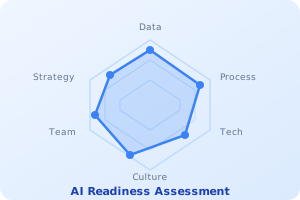
Is Your Operation Ready for Voice AI?
A quick readiness check — no sales pitch, just a clear picture of where you stand.
Take the AI Readiness AssessmentGo Deeper in the Forge Vault
Get AI prompts, implementation templates, SOPs, and call scripts built for distribution companies. 47+ resources and growing — free access.
Access the Forge Vault — FreeAlso free: Live virtual training sessions — Thursdays 1 PM ET