
Can Voice AI Actually Handle Complex B2B Conversations?


Modern speech recognition systems achieve over 90% accuracy in optimal conditions, according to AssemblyAI's 2025 benchmarks. But accuracy on clean audio and accuracy in a noisy distribution warehouse with industry jargon are different things entirely. The real question isn't whether voice AI can transcribe speech—it's whether it can handle the messy, multi-step, context-heavy conversations that define B2B operations.
The Skepticism Is Earned
Distribution operators have good reason to doubt voice AI. The industry has been burned before—by IVR systems that couldn't understand basic requests, by chatbots that looped endlessly, by demos that bore no resemblance to production conditions.
Deepgram's 2025 production metrics research documented 2.8× to 5.7× degradation in accuracy between controlled benchmarks and real-world deployments. Controlled medical dictation achieved around 8.7% word error rate; multi-speaker clinical conversations exceeded 50%. Enterprise environments with background noise, accents, and domain-specific vocabulary fall somewhere in between.
But the technology moved significantly between 2023 and 2025. Three specific advances changed the B2B calculus.
What Actually Changed
Context windows expanded dramatically. Modern voice AI systems maintain context not just within a single conversation but across conversation history. When a repeat customer calls, the system can reference their last ten interactions, outstanding orders, preferences, and typical patterns. This contextual awareness is what separates useful B2B interactions from consumer-grade "set a timer" commands.
Reasoning improved. Large language models can now parse multi-step requests that would have been impossible two years ago. A request like "Change my delivery from Tuesday to Thursday, but only for the refrigerated items, and add a case of Product X if you have it in stock" involves three distinct actions with conditional logic. Current systems can decompose and execute this kind of request reliably.
Latency dropped below the perception threshold. AgentVoice's 2025 market analysis noted that startups focused on ultra-low-latency synthesis now achieve sub-100ms generation times. Synthflow reports sub-500ms end-to-end latency for complete voice interactions. When the technology responds in a human-like rhythm, the conversational friction largely disappears.
By 2026, 80% of businesses plan to integrate AI-driven voice technology into their customer service operations.
— aiOla, State of Voice AI 2025
Where Voice AI Excels in B2B
Based on deployment data from enterprise voice AI vendors, these categories represent the sweet spot—structured enough for automation, high-volume enough to justify the investment:
Order status and delivery tracking. "Where's my order?" represents 30–50% of inbound calls at most distributors. The answers live in structured databases. Voice AI handles these instantly, no human needed.
Routine order placement. Standing orders, reorders, and template-based purchases follow predictable patterns. Customer history provides context. The AI confirms details before processing. Enterprise vendors report that repeat orders can be completed in under two minutes by voice, compared to 8–12 minutes through traditional channels.
Inventory and availability checks. Real-time lookups across warehouse locations, with automatic suggestions for alternatives when items are unavailable. This requires live ERP integration but the query pattern is straightforward.
Account information. Balances, payment status, credit terms, invoice details—all queryable data with clear, structured answers.
Scheduling and rescheduling. Delivery modifications, appointment changes, and logistics coordination where the constraints are expressible and the data is structured.
Pricing lookups. Customer-specific pricing, volume discounts, and promotional rates retrieved instantly based on account context.
Where Humans Are Still Essential
Honesty about limitations matters more than hype. Voice AI struggles with—or should not attempt—several categories of B2B interaction:
High-stakes negotiation. Large contracts, competitive bid situations, and strategic pricing decisions require reading between the lines, understanding leverage, and making judgment calls that go beyond data retrieval.
Emotionally charged situations. A genuinely upset customer who just lost a major job because of a late delivery needs human empathy, not an algorithm. AI can handle routine complaints, but escalation to a human must be seamless for situations requiring emotional intelligence.
Highly ambiguous requests. "Something like what we ordered last year but different" requires creative problem-solving and clarifying questions that current AI handles inconsistently.
Relationship building. The long-term rapport between a sales rep and a key account—reading subtle cues, building trust over repeated interactions, knowing when to push and when to back off—remains distinctly human territory.
Free Live AI Sessions for B2B
Free 1-hour live sessions on AI automation for B2B — voice AI, CRM, operations, and more. Join on Zoom with live demos and Q&A.
See Upcoming SessionsThe Realistic Split
Industry data from enterprise voice AI deployments converges on a consistent pattern: roughly 60–70% of inbound B2B interactions are structured enough for voice AI to handle autonomously. The remaining 30–40% benefit from human involvement.
This isn't a story about replacing people. It's about division of labor. Customer service teams shouldn't spend half their day answering "where's my order?" They should handle the complex issues, the relationship moments, the situations that require judgment. Voice AI makes that division possible by absorbing the repetitive volume.
About 70% of CX leaders now plan to incorporate generative AI—including advanced voice and chat assistants—within the next two years, according to Deloitte's customer experience research. The organizations moving fastest are those that frame AI as a complement to their team, not a replacement.
Implementation Realities
The technology capability exists. Translating it into real value requires getting several things right:
System integration is non-negotiable. Voice AI without live access to order management, inventory, pricing, and customer data is just a talking chatbot. Every "I don't have access to that information" or "let me transfer you" moment undermines the value proposition.
Escalation must be seamless. When AI reaches its limits, the handoff to a human needs to be instant and context-preserving. The agent should brief the human on what was discussed, what the customer needs, and what's already been attempted. Bad escalation destroys the value good automation created.
Domain training matters. Generic voice AI doesn't know that "the blue stuff" means a specific cleaning product at your company, or that "half a truck" means a specific order quantity. aiOla's work on zero-shot jargon recognition is promising, but most implementations still require domain-specific tuning to handle the terminology, abbreviations, and shorthand that B2B customers actually use.
Measurement drives improvement. Every voice interaction generates data about what customers ask, how they phrase requests, and where the AI fails. Organizations that systematically analyze this data and feed it back into training see continuous improvement in resolution rates and customer satisfaction.
The Bottom Line
Can voice AI handle complex B2B conversations? Yes—with clear boundaries.
It handles operational complexity well: multi-step orders, conditional requests, inventory checks, pricing queries, scheduling changes. These represent the majority of customer interactions at most distributors.
It handles relational and emotional complexity poorly: strategic negotiations, upset customers, ambiguous creative requests. These still need people.
The winning approach is not AI-or-humans but AI-for-routine, humans-for-exceptional. That combination delivers better service at lower cost than either approach alone. The technology is ready. The implementation details determine whether it works.
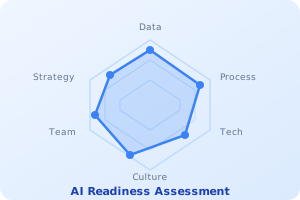
Is Your Operation Ready for Voice AI?
A quick readiness check — no sales pitch, just a clear picture of where you stand.
Take the AI Readiness AssessmentGo Deeper in the Forge Vault
Get AI prompts, implementation templates, SOPs, and call scripts built for distribution companies. 47+ resources and growing — free access.
Access the Forge Vault — FreeAlso free: Live virtual training sessions — Thursdays 1 PM ET