
SaaS Panic: Why Traditional Software Vendors Are Terrified of AI


In Q1 2025, aggregate net new ARR added across the cloud software universe dropped to $1.65 billion—down 29% from $2.33 billion in Q1 2024, according to data tracked by Clouded Judgement's Jamin Ball. A trillion dollars has evaporated from software stocks. Bain & Company describes a "sharp reset in valuations" driven by AI-driven disruption, slowing retention, and a growing divide between incumbents and future winners.
The SaaS model that generated billions in recurring revenue for two decades is under structural pressure. For distribution companies evaluating software, understanding why matters more than the stock ticker numbers suggest.
The Bargain That Stopped Working
The SaaS pitch was straightforward: hosted software, monthly payments, automatic updates, new features over time. Compared to buying shrink-wrapped software and paying consultants to upgrade it every few years, the model lowered barriers, spread costs, and shifted risk from buyers to vendors.
But the model carried a hidden assumption—that software complexity justified the ongoing cost. Configuration, maintenance, integration, training: the subscription covered not just the product but the continuous care that enterprise software demanded.
According to a February 2026 Forbes analysis, AI is restructuring B2B software economics so fundamentally that some analysts have labeled the current environment a "SaaSpocalypse"—a permanent repricing of what buyers should expect from their vendors.
AI changes the equation. When software can configure itself, when natural language replaces training manuals, when agents handle the work that humans previously needed screens and forms to do—the justification for per-seat subscriptions weakens.
Why Incumbents Struggle to Adapt
Existing SaaS vendors aren't ignoring AI. Most have added "AI" to their marketing in the past 18 months. But adding AI features to legacy architectures faces structural problems that marketing can't solve.
Revenue model conflict. SaaS vendors charge per-seat or per-user. AI reduces headcount needs. Every genuinely effective AI feature cannibalizes the vendor's own revenue base. As Bain's 2025 Technology Report noted, this creates a growing divide between vendors who can reinvent their business model and those financially trapped by the old one.
Technical debt. Code written in 2010 wasn't designed for real-time inference or agent-based workflows. According to Gartner, fewer than 5% of enterprise applications featured task-specific AI agents in 2025—though the firm projects that number will reach 40% by the end of 2026. The gap between "AI on slides" and "AI in production" remains enormous for most legacy platforms.
Talent competition. Building AI-native products requires different skills than maintaining CRUD applications. The engineers who can build agentic systems have options, and retrofitting bolt-on features at a legacy vendor isn't the most compelling pitch.
Customer base inertia. Existing customers bought the old product. Radical changes risk churn. Vendors end up trapped—serving their current base while competitors build for the next generation of buyers.
The AI-Washing Problem
Gartner predicted that over 40% of agentic AI projects would be canceled by the end of 2027, based on a January 2025 poll showing that while 61% of organizations reported some AI investment, many lacked the data infrastructure and governance to deliver results. The rush to claim AI capabilities has outpaced the ability to deliver them.
In distribution software specifically, the pattern is consistent: vendors rebrand existing features with AI terminology. Basic dashboards become "AI-powered insights." If-then rules become "intelligent automation." A ChatGPT wrapper with limited system access becomes an "AI assistant."
"The challenge for buyers isn't whether vendors claim AI—they all do now. The challenge is distinguishing between AI that fundamentally changes how work gets done and AI that's a marketing bullet point on existing functionality." — Bain & Company, Technology Report 2025
For distribution companies, the practical test is simple: can the AI actually take action within the system, or does it only surface recommendations for a human to execute manually? The former is transformation. The latter is a feature update with better branding.
Free Live AI Sessions for B2B
Free 1-hour live sessions on AI automation for B2B — voice AI, CRM, operations, and more. Join on Zoom with live demos and Q&A.
See Upcoming SessionsDistribution Is Particularly Exposed
Distribution is ripe for AI disruption because so much work is repetitive, rule-based, and high-volume—exactly the profile where AI agents deliver the most value. According to a Gartner supply chain survey, 67% of supply chain executives reported that their organizations had fully or partially automated key processes using AI by 2025.
McKinsey's research on AI in distribution operations found that early movers stand to increase their cash flow by 122%, while late adopters could lose up to 23% of theirs. That gap is widening as AI capabilities mature.
Order processing, customer service inquiries, inventory monitoring, route optimization, pricing and quoting, collections follow-up—these are tasks that traditional distribution software was built to help humans do faster. AI-native platforms do the tasks themselves. That's not incremental improvement. It's category redefinition.
Gartner projects that by 2028, AI agents will command $15 trillion in B2B purchases—a signal that autonomous buying and selling is moving from concept to reality faster than most legacy software architectures can accommodate.
What This Means for Buying Decisions
For distribution companies evaluating software, the SaaS panic should inform several aspects of the process:
Question "AI features" claims. Ask vendors to demonstrate AI in action, not on slides. Can the system take autonomous action—placing a reorder, responding to a customer inquiry, adjusting a price—or does it only generate recommendations for a human to review? The distinction matters.
Evaluate architecture, not features. A product built in 2012 with AI bolted on will not match one built AI-first. Ask when the core platform was architected. Ask about data infrastructure. Ask how the AI integrates with business logic versus sitting alongside it.
Assess vendor financial health. Vendors under margin pressure may cut R&D, reduce support quality, or get acquired by private equity firms focused on cost extraction rather than product investment. The SaaStr data showing a 29% decline in net new ARR suggests that many cloud vendors are entering a period of financial stress that will affect product roadmaps.
Rethink pricing models. Per-seat pricing made sense when software needed users at screens. With AI handling work, outcome-based or transaction-based pricing aligns incentives better. Vendors charging AI premiums on top of per-seat fees are double-dipping—charging for the old model and the new one simultaneously.
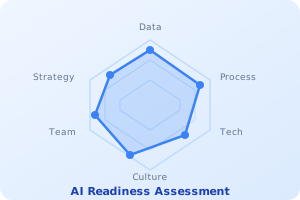
Is Your Distribution Software Keeping Up?
5-minute assessment to see where your current tools stand against AI-native alternatives. No sales pitch—just data.
Take the AI Readiness AssessmentThe Window Is Open
The technology gap between legacy SaaS with bolted-on AI and platforms built AI-native is at its widest point. That gap will narrow as incumbents catch up or get acquired, but the operational advantages available to early movers compound over time.
Companies that adopt AI-native distribution tools now build institutional knowledge, process optimization, and competitive advantages that become harder for competitors to replicate later. McKinsey's 122% cash flow advantage for early movers isn't theoretical—it reflects the compounding returns of operational efficiency gains.
The SaaS model isn't dying. But it is being repriced, restructured, and in many cases replaced by something fundamentally different. Distribution companies choosing software today are choosing between platforms built for where the industry is going and platforms built for where it's been.
Go Deeper in the Forge Vault
Get AI prompts, implementation templates, SOPs, and call scripts built for distribution companies. 47+ resources and growing — free access.
Access the Forge Vault — FreeAlso free: Live virtual training sessions — Thursdays 1 PM ET