Manual Data Entry Is Costing Distribution Companies $28,500 Per Employee


A 2025 survey of 500 U.S. professionals conducted by Parseur and QuestionPro put a hard number on something distribution leaders have long suspected: manual data entry costs American companies an average of $28,500 per employee per year. Employees reported spending more than nine hours per week transferring data between formats — from emails to spreadsheets, from paper forms to ERP systems, from one application to another.
For a distribution company with 50 employees, that's $1.4 million annually in labor absorbed by typing information into boxes. And the financial cost is only part of the damage.
56% of employees report burnout from repetitive data tasks
— Parseur/QuestionPro 2025 Manual Data Entry Report. Over half of workers surveyed said repetitive data entry was a significant source of workplace burnout, contributing to higher turnover risk.
Where the Burden Actually Comes From
Not all data entry is created equal. In distribution operations, the burden concentrates in four areas, each with a different root cause and a different fix.
Duplicate entry across disconnected systems. This is the biggest source. A customer address gets typed into the CRM, then again into the order management system, then again into the shipping platform. The same information, entered three or four times, because the systems don't talk to each other. According to BetterCloud's 2025 State of SaaS report, the average company runs 106 SaaS applications — and the integration between them is often manual.
Paper-to-digital translation. Field sales reps take notes on paper, then transcribe them into the CRM back at the office. Warehouse workers fill out receiving forms by hand, then someone keys them in. Delivery drivers get paper signatures, then someone enters confirmation data. Each translation step costs time and introduces errors.
Email and document extraction. Purchase orders arrive as PDF attachments. Customers send pricing requests via email. Supplier invoices come in dozens of formats. Someone has to read each document, identify the relevant data, and type it into the appropriate system. For high-volume distributors processing hundreds of orders per day, this alone can consume multiple full-time positions.
Cross-system copy-paste. Exporting data from one system, reformatting it in a spreadsheet, and importing it into another. End-of-month reporting that requires pulling numbers from five different tools. Reconciliation workflows that exist only because two systems don't share a data model.
The Error Problem Compounds the Cost
Manual data entry doesn't just consume time — it produces mistakes. According to DocuClipper's 2025 compilation of data entry statistics, human data entry has an accuracy rate between 96% and 99%, compared to 99.96% to 99.99% for automated systems. On 10,000 entries, that's the difference between 100-400 human errors and 1-4 automated errors.
In distribution, those errors have downstream consequences. A wrong shipping address means a failed delivery and a reshipment. An incorrect quantity means a short shipment and a customer complaint. A pricing error on an invoice means a dispute that takes weeks to resolve. Each error costs far more to fix than it cost to make.
Humans make 100x more data entry errors than automated systems
— DocuClipper, 2025 Data Entry Statistics. For every 10,000 entries, automated systems produce 1-4 errors versus 100-400 for manual entry.
One mid-market distributor processing 10,000 orders per month with a 2.5% error rate was generating 250 order errors monthly. At an estimated correction cost of $25-50 per error (staff time, reshipping, credits), that's $6,000-12,000 per month in error-related costs — on top of the labor cost of the data entry itself.
What 80% Reduction Actually Looks Like
The Parseur study found that among companies that had adopted automation tools, 96.5% reported significant workload reduction. The industry consensus, supported by multiple studies, is that automation typically eliminates around 80% of manual data entry volume.
That doesn't mean eliminating 80% of people. It means redirecting 80% of their data entry time toward higher-value work. The Parseur survey found that employees overwhelmingly wanted to spend reclaimed time on strategic planning, customer experience improvement, and revenue-focused activities — not more administrative tasks.
Here's what the reduction looks like in practice across common distribution workflows:
Order entry: AI-powered document processing reads incoming purchase orders (email, PDF, EDI), extracts line items, quantities, and shipping details, and creates draft orders for human review. A process that took 8-10 minutes per order manually takes 1-2 minutes of review time. For a distributor processing 200 orders per day, that's roughly 20 hours of labor reclaimed daily.
Customer data updates: When a customer's information changes in one system, it propagates automatically to every connected system. Instead of a 15-minute update across four platforms, the change happens once and syncs instantly.
Field capture: Mobile apps replace paper forms for sales visits, delivery confirmations, and warehouse receiving. Data enters the system at the point of activity — no transcription step, no delay, no translation errors.
Reporting: Automated data pipelines replace the weekly ritual of exporting from five systems, pasting into a master spreadsheet, fixing the formatting, and emailing it to leadership. Reports generate themselves from live data.
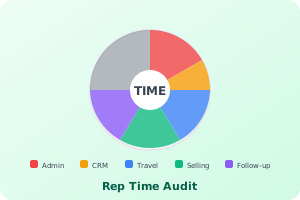
Where Does Your Sales Team Actually Spend Their Time?
Quick audit reveals how much time reps spend selling vs. admin, CRM, and manual tasks.
Run the Rep Time AuditA Practical Reduction Roadmap
The path from data entry chaos to automation follows a predictable sequence. Companies that try to automate everything at once typically automate nothing well. A phased approach works better.
Weeks 1-2: Audit. Before optimizing anything, measure where data entry is actually happening. For one week, ask team members to track every instance: what system, what data source, how long, and whether the information already exists somewhere else. The results almost always surprise leadership — the biggest time sinks are rarely where expected.
Weeks 3-4: Prioritize. From the audit, identify entries that are repetitive, consistent, high-volume, and low-complexity. These are the automation candidates with the fastest payback. Duplicate entry across systems is usually the single biggest opportunity.
Month 2: Core integrations. Connect the primary systems that share data. The highest-value integrations for distributors are typically CRM to order management (customer data and order history), order management to accounting (invoices and payments), and mobile to core systems (field data syncing in real time).
Month 3: Add intelligence. Layer AI capabilities onto the integrated foundation: email parsing that extracts order details from incoming messages, document OCR that processes PDFs into structured data, voice capture that lets field teams dictate notes for automatic transcription and categorization.
Month 4+: Refine. Tune accuracy based on corrections, expand to additional document types and system connections, and target remaining manual entry points. The 80% reduction is typically achievable within the first 90 days; the remaining optimization is incremental.
The Obstacles Are Mostly Perceived
Three objections come up repeatedly, and each one is less solid than it appears:
"Our systems are too old to integrate." Modern integration platforms (iPaaS tools like Workato, Celigo, and Boomi) can connect almost any system — including legacy ERPs with no API. If there's a database, a file export, or even a screen to scrape, there's an integration path. The question is cost-benefit, not technical feasibility.
"Our processes are too complex for automation." They don't have to be 100% automated. If 80% of orders follow a standard pattern and 20% require human judgment, automating the standard orders still eliminates the vast majority of manual work. The humans can focus on the exceptions that actually require their expertise.
"We can't afford a big technology project." The Parseur study quantifies the cost of doing nothing: $28,500 per employee per year. For a 50-person company, that's $1.4 million in annual data entry costs. Even a significant automation investment pays back within months at those numbers.
How Much Revenue Are You Leaving on the Table?
Free 5-minute assessment reveals where your distribution business is silently leaking 5-15% of potential revenue.
Take the Free AssessmentThe Automation Adoption Gap
Perhaps the most striking finding from the Parseur research: 46.2% of businesses surveyed had not adopted any automation tools for data entry. Not because automation didn't work — the 96.5% satisfaction rate among adopters makes that clear — but because of lack of awareness and internal advocacy.
Nearly half of companies are still paying the full data entry tax simply because nobody has built the business case internally. The data to make that case now exists. The technology to act on it is mature and accessible. The only remaining question is who raises the issue first — and whether that happens before or after competitors have already made the shift.
By 2030, the Parseur study projects, automation of manual data entry will be industry-standard. The companies moving now are gaining the competitive and operational advantages that come with being early. The companies waiting are compounding the cost.