
The Real Cost of Running 6–8 Disconnected Tools in Distribution


According to a Boston Consulting Group paper citing Gartner data, software's share of overall technology budgets grew 50% between 2019 and 2025—from 13% to 21%. Companies are spending more on software than ever. And for many mid-market distributors, that spending is spread across six to ten disconnected tools that don't talk to each other.
BetterCloud's 2025 SaaS statistics report found that companies use an average of 80 external SaaS applications. Even small distribution operations typically run separate systems for CRM, ERP, e-commerce, route planning, inventory management, customer service, email marketing, and reporting. Each tool solved a real problem when it was added. Together, they create a bigger one.
The subscription fees are just the beginning.
The Visible Cost: Subscription Fees
A typical $50–70M distributor running a disconnected stack pays roughly $120,000–$150,000 annually in software subscriptions: ERP ($40–50K), CRM ($20–25K), e-commerce ($15–20K), route planning ($10–15K), inventory optimization ($8–10K), helpdesk ($5–8K), email marketing ($4–6K), and BI/reporting ($6–10K).
That's real money for a mid-market operation. But it accounts for maybe a quarter of the true cost of disconnection.
Hidden Cost 1: Your People Are the Integration Layer
When systems don't talk to each other, employees bridge the gap manually. A customer service rep answering a delivery question has to look up the customer in the CRM, find the order in the ERP, check delivery status in the routing system, and log the interaction back in the CRM. Each context switch burns time—not just the seconds of clicking between windows, but the cognitive load of parsing different interfaces and reconstructing the full picture.
Across a four-person customer service team, this kind of toggling typically consumes 2–3 hours per rep per day. At fully loaded labor costs of $30/hour, that's $75,000–$90,000 annually in productivity lost to integration friction—in one department alone. Sales reps, operations managers, and accounting staff face the same tax.
increase in software's share of IT budgets between 2019 and 2025
Source: BCG, citing Gartner worldwide IT spending data
Hidden Cost 2: Data Entry Duplication and Drift
New customer? Enter them in the CRM, the ERP, the e-commerce platform, and the email marketing system. That's the same information typed four times—and four opportunities for typos, inconsistencies, and omissions.
The duplication is expensive on its own. But the real damage comes from data drift: over time, records diverge across systems. The CRM has one address; the ERP has another. Which is correct? Someone has to investigate. The Spendflo 2025 analysis of SaaS sprawl found that disconnected workflows lead to duplicated effort, inconsistent reporting, and delayed processes—and that the resulting technical debt slows an organization's ability to scale.
Hidden Cost 3: Decision Latency
"What's our margin on the Johnson account?" sounds like a simple question. Answering it requires sales data from the CRM, order history from the ERP, pricing data from wherever it lives, cost data from inventory, and delivery costs from route planning. In a disconnected stack, getting this answer is a project—export, match, reconcile in a spreadsheet, and pray the customer IDs are consistent across platforms.
Most of the time, the analysis never happens. The question goes unanswered, or gets answered with gut feel instead of data. Decision latency—the time between having a question and having an answer—is one of the most expensive invisible costs in distribution. It's not just the labor; it's the decisions not made, the opportunities missed, and the problems not caught in time.
Learn to Put AI to Work in Your Business
Join our 6-session live course and walk away with real AI workflows running in your operation. Hands-on, practical, no fluff.
See the CourseHidden Cost 4: Error Propagation
Disconnected systems generate errors at every handoff point. A customer gets quoted one price in the CRM and invoiced a different price from the ERP. An order appears in the e-commerce system but doesn't flow to fulfillment. Inventory counts in the system don't match the warehouse floor.
Each error has a direct resolution cost—someone's time to investigate, correct, and apologize. Companies running disconnected stacks typically see 2–4% error rates on transactions. On a unified platform, that drops below 1%. On 50,000 annual transactions, that's the difference between 2,000 errors and 500 errors. At a conservative $50 per error to resolve, that's $75,000 in error-related cost that doesn't appear in any budget line item.
The larger cost is often invisible: eroded customer trust, frayed relationships, and accounts that eventually leave without citing a specific reason.
Hidden Cost 5: Integration Maintenance
Some companies try to solve disconnection through integration—APIs, middleware, Zapier automations, custom scripts. These help, but they create their own maintenance burden: API changes break integrations (vendors update APIs more often than most companies expect), sync jobs fail silently, edge cases create mismatches, and the person who built the integrations eventually leaves.
According to InformationWeek's 2025 analysis of SaaS spending trends, CIOs are increasingly focused on tool sprawl as a primary cost driver—not just the subscription fees, but the hidden infrastructure required to keep disconnected tools functioning as a pseudo-system.
Hidden Cost 6: The AI Readiness Gap
This is the cost that few companies are counting yet, but it may be the largest. AI needs unified context. A voice AI handling customer calls needs order history, preferences, outstanding issues, and account status—instantly, from one data source. With disconnected systems, the AI would need to query four or five APIs, reconcile conflicting data, and reason across incompatible schemas. It's technically possible but practically infeasible.
Companies with unified data will deploy AI that handles a significant share of routine customer interactions. Companies with disconnected data will deploy chatbots that say "let me transfer you to an agent." The gap will translate directly to cost structure and customer experience, and it will widen every year.

The Math Adds Up Fast
For a typical $50–70M distributor, the total annual cost of a disconnected tool stack looks roughly like this:
Software subscriptions: ~$130K. Human integration labor: ~$85K. Data entry duplication: ~$25K. Decision latency (opportunity cost): ~$50K+. Error resolution: ~$75K. Integration maintenance: ~$40K. Total: $400K+ per year—before counting the strategic cost of not being AI-ready.
That's roughly three to four times the visible software cost.
The Consolidation Alternative
The answer isn't better integrations—it's fewer systems. A unified platform that handles CRM, order management, inventory, customer communications, and analytics on a single data model eliminates integration friction by design. One login, one data entry point, one source of truth.
Distributors that consolidate typically eliminate four to six point solutions. The subscription savings alone often justify the switch. The hidden cost savings—labor efficiency, error reduction, decision speed—are pure upside. And unified data makes AI capabilities actually work, without integration projects or data reconciliation.
Zylo's 2025 SaaS Management Index, analyzing more than $40 billion in SaaS spend across its customer base, reported that mid-sized firms reduced SaaS application counts by 29% in 2025. The consolidation trend is accelerating—and distribution companies that move early gain compounding advantages in efficiency, data quality, and AI readiness.
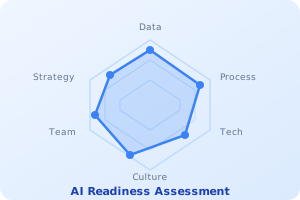
Is Your Tech Stack Holding You Back?
This 5-minute assessment evaluates your current systems and gives you an honest ERP modernization roadmap.
Take the ERP Modernization AssessmentStay Ahead of the Curve
Get weekly insights on AI, automation, and B2B operations delivered to your inbox.
Go Deeper in the Forge Vault
Get AI prompts, implementation templates, SOPs, and call scripts built for distribution companies. 47+ resources and growing — free access.
Access the Forge Vault — FreeAlso free: Live virtual training sessions — Thursdays 1 PM ET