
Why 80% of AI Projects Fail—and the Five Mistakes Behind It


According to Gartner, only 48% of AI projects make it into production. An Informatica analysis put the broader failure rate even higher—over 80%, twice the failure rate of non-AI IT projects. And Gartner predicted that at least 30% of generative AI projects would be abandoned after proof of concept by the end of 2025, citing poor data quality, escalating costs, and unclear business value.
The striking thing about these failures is how predictable they are. The same five mistakes show up repeatedly, and none of them are technical problems. They are organizational ones—which means they're preventable.
of AI projects make it into production, according to Gartner's survey data
Source: Gartner, cited in Informatica's 2025 AI project analysis
Mistake 1: Starting with the Technology Instead of the Problem
The pattern is familiar: leadership attends a conference, sees an AI demo, and tasks someone with "finding a use case for AI." This is backwards. McKinsey's 2025 State of AI survey found that organizations reporting significant financial returns from AI were twice as likely to have redesigned end-to-end workflows before selecting modeling techniques. They started with the business problem, not the technology.
In distribution, the highest-value AI applications tend to target specific, measurable pain points: demand forecasting accuracy, order error rates, customer churn prediction, document processing throughput. Companies that begin with "where does AI fit?" instead of "what's our most expensive operational problem?" consistently underperform.
The fix: Identify the three most costly operational bottlenecks first. Then evaluate whether AI is the right solution for each—often it isn't, and a simpler process change or software configuration solves the problem faster.
Mistake 2: Underestimating Data Quality Requirements
"We have the data" may be the most dangerous sentence in AI planning. According to Gartner, 85% of AI model failures trace back to poor data quality or a lack of relevant data. Having data and having data that's ready for AI are entirely different things.
The typical pattern: a team identifies data sources, a quick assessment suggests the data is available, the project budgets 10% for data preparation—and data prep ends up consuming 60% of the timeline. The AI then launches on compromised data and produces unreliable results.
For distribution companies, the data quality challenges are specific and well-documented: inconsistent product naming across systems, incomplete customer records, order history scattered across multiple platforms, and pricing data that lives in spreadsheets rather than structured databases.
The fix: Conduct a formal data quality assessment before committing to any AI project. Budget three times what the initial estimate suggests for data preparation. This isn't pessimism—it's the industry baseline.

Mistake 3: Chasing Perfect Instead of Useful
AI projects die in pursuit of perfection. Teams delay launch for months trying to improve accuracy from 92% to 95%, while competitors capture value with 85%-accurate solutions augmented by human oversight.
The math of diminishing returns is unforgiving: going from 80% to 90% accuracy is usually straightforward. Going from 90% to 95% is hard. Going from 95% to 99% can take as long as the entire preceding project combined. Meanwhile, an 85%-accurate system with a human review step often outperforms a 95%-accurate system that took twice as long to deploy—because the faster system has been generating value for months.
The fix: Define "good enough" before the project starts. Set a minimum accuracy threshold that makes the application valuable, plan for human oversight on edge cases, and time-box the project: "We launch in 90 days with whatever accuracy we've achieved."
Free Live AI Sessions for B2B
Free 1-hour live sessions on AI automation for B2B — voice AI, CRM, operations, and more. Join on Zoom with live demos and Q&A.
See Upcoming SessionsMistake 4: Ignoring Change Management
This is the silent killer. The AI works. The integration is solid. The accuracy is great. And nobody uses it.
McKinsey's 2025 survey found that 51% of organizations reported at least one negative AI-related incident in the past 12 months, with inaccuracy being the most common complaint—followed by compliance, reputational, and privacy concerns. When employees don't trust AI outputs, or when the new process doesn't match how they actually work, adoption stalls regardless of technical quality.
In distribution, this plays out in predictable ways: sales reps who ignore AI-generated lead scores because they trust their gut, warehouse managers who override AI-optimized pick routes because "that's not how we do it," customer service teams who bypass AI-suggested responses because they don't trust the recommendations.
The fix: Involve end users in the design process from day one—not as an afterthought, but as genuine co-designers. Build transition periods into the project plan. Invest in internal champions who can influence adoption among peers. And treat low adoption as project failure, not a training problem.
Mistake 5: Treating AI as a One-Time Project
AI implementations that succeed in month one can degrade by month twelve. Business conditions change, data patterns shift, edge cases accumulate. What worked initially becomes less reliable over time—a phenomenon known as model drift.
McKinsey's 2025 survey noted that 92% of firms plan to increase AI budgets within three years, signaling that organizations are beginning to understand AI as an ongoing capability rather than a one-time investment. The companies seeing returns treat AI the same way they treat other critical business functions: with dedicated resources, regular performance reviews, and continuous improvement.
The fix: Budget for ongoing support at 15–20% of implementation cost annually. Establish monitoring dashboards that track accuracy, usage, and error rates. Schedule monthly reviews. Plan for periodic retraining as data and business conditions evolve.
of firms plan to increase AI budgets within three years
Source: McKinsey State of AI survey, 2025
The Common Thread
Across all five mistakes, the pattern is the same: treating AI as a technology project instead of a business capability. Technology projects have budgets, deadlines, and a finish line. Business capabilities require organizational change, ongoing investment, and measurement by business outcomes—not technical milestones.
The companies succeeding with AI in distribution are the ones that invest in data quality as a continuous discipline, iterate toward useful solutions rather than perfect ones, bring their people along through genuine change management, and plan for improvement that never stops. That mindset shift—from project to capability—is worth more than any specific implementation advice.
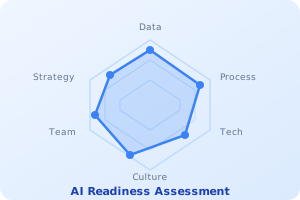
Is Your Business Actually Ready for AI?
Cut through the hype. This 5-minute assessment evaluates your data, processes, team, and tech stack—and gives you an honest roadmap.
Take the AI Readiness AssessmentGo Deeper in the Forge Vault
Get AI prompts, implementation templates, SOPs, and call scripts built for distribution companies. 47+ resources and growing — free access.
Access the Forge Vault — FreeAlso free: Live virtual training sessions — Thursdays 1 PM ET